THE MOMENTOUSNESS OF COMMUNICATIVE LANGUAGE TEACHING APPROACH IN CONTEMPORARY EPOCH.

PROF MANMINDER SINGH ANAND
Asstt. Prof in English, PUNJABI UNIVERSITY NEIGHBOURHOOD CAMPUS, JAITU 151506 Pb

ABSTRACT

The present paper attempts to analyze the conceptual aspects of Communicative language teaching approach , as also to figure out the radical elements in the contemporary  approaches carried out in Europe as well as in India. An attempt has been made to focus on the radical elements in various approaches like Grammar-translation Method , Audio-lingual method or Bi-lingual method and also to compare and contrast their specific preferences. The paper, thus, presents an overview of the speaking , writing & technical skills & how they must be employed having a specific tilt towards radical innovations .

Keywords
communication, approaches , listening , technical drills , Noam Chomsky , language

MOTHERS ECONOMIC RESOURCES AND UNDER-FIVE MORTALITY IN IBADAN, SOUTHWEST NIGERIA

1CHUKWUDEH Stephen Okechukwu & 2Adewole LAWAL

 Postgraduate Students, Department of Sociology, Faculty of the Social Sciences, University of Ibadan, Ibadan, Nigeria.

ABSTRACT

Background:  Under-five mortality is a serious health challenge in Nigeria. The Nigerian government has made concerted effort to reduce the number of children who die before age five years by adopting some global health initiatives, yet the number of children who die before age five in the country is still high in Nigeria. Objective: The study investigates the association between mothers’ economic resources and under-five mortality in Ibadan, Southwest Nigeria. Material and methods: this study was conducted at Akinyele, Ibadan North East, and Ibadan North local government areas in Ibadan, Southwest Nigeria. The Oscar Lewis culture of poverty theory served as the basis of its theoretical underpinning and quantitative primary data was collected through survey technique with the use of questionnaire. A total of 800 mothers were sampled using multi-stage sampling technique. First, stratified sampling technique was used to divide Ibadan into three homogenous groups based on the housing structure and population density of the city. The second stage was the use of simple random sampling technique to select one local government area based on each homogenous group. The third stage was the use of simple random sampling technique to select one locality in each local government areas that has been selected. The last stage was the use of purposive sampling technique to select 800 mothers at the 3 local government areas in Ibadan. Result: The result revealed that mothers economic resources, sources of income, financial support from husband, failure of husband to support their wife, and mothers occupation significantly influence under-five mortality in Ibadan, Southwest Nigeria. However, the prevalence of financial support received from husbands has insignificant influence on under-five mortality in Ibadan, Southwest Nigeria. Conclusion: the data acquired in this study may be used in developing interventions to improve mother’s economic resources and thus contributes to reduction of under-five mortality in Nigeria.

Key words: Economic, Child Mortality, Poverty, Socialization, Unemployment.

A study of Knowledge, Attitudes, and Behavior for the University Students to Choose Abroad the Trip

Pin-Fenn Chou

Department of Business Administration, Far East University, Tainan City, Taiwan

Abstract

 There is an expectation for the university students who go abroad before their graduation. Most students choose foreign tour locations for their trip travel place. There are many kind of disease for relevance tour; however, the knowledge about infectious diseases by the students’ perception will be affecting their attitude and prevention behavior.

    The purpose of this study is to explore the students to participate in the graduation trip and understand to diseases’ knowledge, attitudes, and behavior; and to discuss the causal relationship between the three. The findings all support the study of hypothetical reasoning. Results found that the knowledge affects the attitudes and behavior, respectively; and the attitudes affect the behavior.

Keywords: Knowledge, Attitudes, Behavior

Motivation and Aim

To hold the graduation trip, are the most college students looking forward to things. In recent years, there are convenient transportation, travel television program to reported, and the network information to developed, which can rapidly to pass on the overseas tourism-related messages. According to the above, to cause many associate graduates of universities are attraction to choose the overseas tourist as their graduation trip.

However, many infectious diseases were to spread and to affect the country’s flourishing tourism. Despite the many national has been a number of major infectious diseases occurred, but they may be to lack of relevant experience and knowledge of the disease, caused the epidemic situation to outbreak. So, the students if choose to travel go abroad, who should have enough the knowledge of infectious diseases abroad, then to do their preventive behavior to reduce the chance of infection. Thus, the aim of this study as following:

To discuss the cause relationship is among knowledge, attitude, and behavior.

Review Literature

Infectious disease, it refers to kinds of infectious disease are pathogens or their toxins secreted directly invade, or indirectly through animal or vehicle invade the body, then to occurrence the disease. Factors affecting the distribution of infectious diseases in six categories, such as following:

  1. Ecological to Changes

  Ex: the factor of global warming is caused by land use way to changed.

  1. Human factors
  2. The prevalence of international travel and business
  3. Factors of technology and business operation
  4. bacterial variants

Ex: producing the resistance to the action of a drug

  1. The collapse of public health measures

Spreading of infectious diseases, not only affect people’s health, but also the economic will be affected in the countries. Particularly, depend on the tourism as the major income for the country, if the cause of infectious diseases was to spread and to result in the tourists reduce to visit, that will have a significant impact on countries’ income.

The model concept of knowledge, attitudes, and behavior (KAB) by Allport (1935) proposed. This mode is described healthy behavior as a mode, the theoretical is based the personal get the relevant behavior information, then to occurs the reaction with a consistent of their attitude and behavior.

Heck et al. (2003) were use the model of KAP to investigate the infectious disease research in tourists of European. The results found that the most respondents do not understand the behavior of high-risk areas for malaria and to adopt the measures prevention. This reason may be these tourists choose their travel destinations are almost low-risk country areas. Hamer and Connor’s (2004) study, is also to survey the knowledge and attitudes of health issue about travelers’ trip. In the United States  the passengers age of over 18 to go abroad , there are 64% passengers did not to seek travel health to advice; among of them, there is over 42% of passengers due to they did not understanding the travel-related health knowledge.

Research Method

This study use the questionnaire to investigation, that items were depend on the literature and according to the situation of infectious diseases to modify. There are 20 items revised questionnaire to measure knowledge, attitudes, and behavior. To measure are taken five-point scale. To measure the knowledge items were from 1 = very unaware, to 5 = very aware. To measure the items of attitude and behavior were from 1= very disagree to 5= very agree.

The research hypotheses are as following:

H1. There is a significant relationship between knowledge and attitude relevant disease.

H2. There is a significant relationship between knowledge and behavior relevant disease.

H3. There is a significant relationship between attitude and behavior relevant disease.

Empirical

In this partly, this model will be empirical the model that after tested the reliability and validity. For reliability, the Cronbach’s α value were 0.91, 0.69, and 0.66 in knowledge, attitude, and behavior constructs, respectively. Although the Cronbach’s α value of attitude and behavior lower than 0.7, however, they were reached the accept threshold. Then the model empirical analysis, the indicators were χ2/df = 2.26,CFI=0.92,GFI=0.90,AGFI=0.87,RMR=0.05,RMSEA=0.07. These indicators were reached the accepted threshold level.

In addition, the values of CR and AVE were tested. The values of CR were 0.91, 0.80, and 0.78 in knowledge, attitude, and behavior constructs, respectively. The values of AVE were 0.50, 0.50, and 0.48 in three constructs knowledge, attitude, and behavior, respectively. Although the AVE was not reached 0.5 for threshold in behavior construct, the model still can called the accepted model.

Further, the hypotheses were tested. By the path analysis, the results reported that the knowledge affects the attitude (p=0.00), and presentation a positively and significantly. The H1 was supported. The knowledge also had a positively and significantly to affect the behavior (p=0.00). So the H2 was supported. The attitude affects the behavior, the result indicate that a positively and significantly (p=0.00). The H3 was also supported.

Conclusion

The main purpose of this study was to understand the students of university if choose to participate in graduation trip they for perception disease knowledge, attitudes, and behavior. And also to test the causal relationship between the above three constructs. The results to confirmed that the students conception the knowledge of the disease, were to affect their attitude and behavior; and also the attitude also to affect behavior.

Reference

  1.  Allport, G. W. (1935). Attitudes. In C. M. Murchison (Ed.), Handbook of Social Psychology. Winchester, MA: Clark University
  2. Hamer, D. H. and Connor, B. A. (2004). Travel Health Knowledge, Attitudes and Practices among United States Journal of Travel Medicine, 11(1): 23-26.
  3. Herck, K. V., Castelli, F., Zuckerman, J., Nothdurft, H., Damme, P. V., Dahlgren, A. L., Gargalianos, P., Rogelio, L. V., Overbosch, D., Caumes, E., Walker, E., Gisler, S., Steffen, R. (2004). Knowledge, Attitudes and Practices in Travel-related Infectious Diseases: The European Airport Survey. Journal of Travel Medicine, 11(1): 3-8

Call for Book Chapter for Social Science Book

Dear Professor/Lecturer/Scholar

Sorry to intrude upon your precious time, but I assure you that you can gain more after reading and acting upon our request to contribute a chapter to the book titled “An Introduction to Sociology in India” with ISBN no. and edited by editor of International Journal of Research. Publication of your book chapter will add more value to academic performance record (API) for your career advancement.

The book will be ready for publication by May 30th, 2016 and contributing authors will get a complimentary copy delivered to them in next one week of the publication of book in online version. Additionally, authors will receive a certificate of publication for the book. Your book will be indexed in Google Scholar to increase the citation of the work.

The published book will be internationally distributed through the collaboration of Amazon and Google Books.

The completed chapter or research paper for the book can be sent to editor@edupediapublications.org

Please mention ‘Chapter for Book’ in subject line of mail to us.

The deadline for submission is 25th May 2016

For details please refer to the attached file.


Domestic Violence against Women: Issues and Challenges

Researcher                                                                                                                     Guide

Mrs.Abhilasha Gaur Saraswat                                                                  Dr. Anupma Mehrotra

Lecturer , Home-Science                                                                  Associate Prof,Home –Science

SRS Girls Degree College, Bareilly.                                                DAKPG College,Moradabad


In ancient India, women enjoyed a significant role not only at home but in the society as whole. Many Vedic hymns are attributed to the women sages. The dialogue between Gargi and Yajnavalkya in the Brihadaranyaka Upanishad reflects the position that women held in the public sphere . The Turkish and Afghan invaders changed the gender equation in the sub – continent . The locals having lost the battle into subjection were coerced to hand over their women and so to protect the honour and chastity of the women became a major societal aim for the local population. The purdah system came in vogue as a result. A series of superstition and oppressive customs were manufactured that confined women within the four walls of their house. The patriarchy dominance was total. The male dominant society would not give women due regard and respect and the system continues to linger even in the twenty-first century.

As its most basic and obvious level, “Violence is an act carried out with the intention or perceived intention of physically hurting another person .” Adding the gender dimension to that definition amplifies it to include violent acts perpetrated on women because they are women.Women are vulnerable to various forms of violent treatment for several reasons .First and foremost because of being female , a women is subjected to rape , female infanticide and sex related crimes .Secondly because of mere relationship to a man a woman is vulnerable to domestic violence , dowry , murder etc. Finally , because of the social group to which she belongs , in times of war, riots, or ethnic caste or class violence, a woman may be brutalized as a means of humiliating the community to which she belongs. Wife beating knows no class, race or religious distinctions particularly in our country. Women battering is not just an aberration the behaviour of a number of disturbed men; it is a violent manifestation of a male domination over women and the patriarchal attitude that sees women, especially wives as the property of men.

Various forms of domestic violence

The situation of Indian women cannot be fully understood without fully discussing the issue of violence committed against women throughout their life cycle – ranging from foeticides ,  infanticides, torture, rape, molestation, battering, trafficking, prostitution, forced marriage, sterilization, dowry death, custodial violence and so on. According to the UN definition,  the deprivation and denial of opportunities for basic human amenities and means of livelihood like health, education, training, skill building etc.are also part of violence against women. In recent years a new dimension has been added by the terrorist violence in some parts of the country, which has forced people to migrate from their native places. Women have become the worst sufferers  in the process. Violence against women is a reflection of the deep rooted “gender ideology “ of the society.Often the crimes are committed by people who are traditionally supposed to be their protectors. But the victims ,specially the sexually abused girls and women get the burnt of the act more than the abuser. Domestic violence is a means to keep women within the contrast of socially accepted decision makers. It is also a preventive measure for defying male authority and interference.Rape, molestation, kidnapping / abduction, eve-teasing / sexual harassment, dowry deaths and his relatives comprise the major crimes against women in the country. During the past one decade a rising tendency of violence against women and stepping up of trafficking and abuse of women has been noticed. Considerable rise in cruelty towards women within matrimonial homes shows the declining status of women.Domestic Violence includes harassment, maltreatment, brutality or cruelty and even the threat of assault-intimidation. It includes physical injury , as well as willfully or knowingly placing or attempting to place a spouse in fear of injury and compelling the spouse by force or threat to engage in any conduct or act, sexual or otherwise, from which the spouse has the right to abstain. Confining or detaining the spouse against one’s will or damaging property are also considered as acts of violence(Bedi,1998).One of the commonest forms of violence is battering – i.e.,Beating of women by men. Battering produces emotional as well as physical scars. While the bruises or knife wounds fade, the emotional injuries slowly kill the spirit. Psychological abuse is very difficult to capture in studies. It has been found that severe psychological stress and living under terror and the mental torture of violence can lead to self- destructive behaviour and fatal consequences such as suicides (Heise, Pitanguy and Germain,1994;IPPF,1998;Rao,1997).

The National Crime Records Bureau (NCRB) Report for the year 2011 highlights some staggering statistics about the domestic violence against women. The percentage share of domestic violence against women in the cognizable crime has grown from 3.8% in 2007 to 4.3%  in 2011. According to the report of National Commission For Women (2015) more than 9700 cases of atrocities against women, including domestic violence and rape, have been registered since April one this year, with Uttar Pradesh seeing the highest number of such cases.

Factors perpetuating domestic violence

The various factors that perpetuate domestic violence can be divided under the following categories:

Cultural

Gender specific socialization                                                                                                               *Cultural definitions of appropriate sex roles                                                                                           Expectations of roles within relationships.                                                                                                                Belief in the inherent superiority of males.                                                                                                   Values that give men proprietary rights over women and girls.                                                                                                                                                                                        Notion of the family as the private sphere and under male control.                                                              *Customs of marriage (bride price / dowry).                                                                                                 Acceptability of violence as a means to resolve conflict.

Economic

Women’s economic dependence on men.                                                                                           Limited access to cash and credit.                                                                                                         Discriminatory laws regarding inheritance, property rights, use of communal lands.                                   Maintenance after divorce or widowhood.                                                                                                                      Limited access to employment in formal and informal sectors.                                                                  Limited access to education and training for women.

Political

Under-representation of women in power, politics, the media and in the legal and medical  professions.                                                                                                                                                     Domestic violence not taken seriously.                                                                                                                       Notions of family being private and beyond control of the state.                                                                                                                                                                                                                                                Risk of challenge to status quo/religious laws.                                                                                                Limited organization of women as a political force.                                                                                      Limited participation of women in organized political system.

Legal

Lesser legal status of women either by written law and/or by practice.                                                               Laws regarding divorce, child custody, maintenance and inheritance.                                                             Legal definitions of rape and domestic abuse.                                                                                                                                           Low levels of legal literacy among women.                                                                                               *Insensitive treatment of women and girls by police and judiciary.

The above mentioned factors act as challenges faced by the society and its members , specially females who have to face them daily in their routine in one form or the other. Essentially, violence happens in three contexts :- the family, the community, and the state. At each point key social institutions fulfill critical and interactive roles in defining, legitimating and maintaining the violence.                                                                                                                                        The Family                                                                                                                                          The family is a major site of violence. A family is vulnerable even before birth as sex-determination tests now provide the means to selectively abort the female foetus. During childhood, a girl child is often deprived of food and medical care in favour of her male siblings. While her mother is systematically disciplined, through beatings, to fulfill her domestic duties towards the husband and family, Amartya Sen’s 1990 Essay “ More Than 100 Million Women Are Missing”,revealed that due to a complex interaction of cultural and economic dynamics, played out largely through decision made in the home against the well being of females , there are infact regions in the world where the ratio of women to men is dramatically imbalanced. Overt control of a woman’s sexuality, through either forced pregnancy of forced abortion by the male, is another form of gender violence perpetrated within the family .                                      The Community                                                                                                                   “Community”, the social, cultural, religious, ethnic, or racial reference groups – those from which people derive sense of identity and key values play a critical role in reinforcing the structure of the family and the position of women within it. Female circumcision (more accurately described as genital mutilation) occurs not only with the moral support of the cultural community , but also by persons regarded as agents of the community, such as local healers or midwives. Witch-burning, sati, punishment for extramarital sex including rape and other forms of physical chastisement are among additional practices of gender violence perpetrated towards women in the name of preserving ethnic of religious integrity. At the level of community, the communication media play a role in perpetrating violence against women through overt pornography, or graphic expressions of female sexual subjugation through violence.                  The State                                                                                                                                            The third location of gender violence is at the level of the State itself, although State culpability is difficult to categorize. Establishing State accountability in gender violence is elusive since most states consider acts of violence towards women to be “private “ in nature and carried out by non-state agents. Rape and torture of woman in detention by their custodians is the most obvious situation in which the State can be identified as a direct agent of gender violence, overt government policies, such as forced sterilization or experimentation on women with unsafe drugs, are also examples of State-sponsored gender violence. Finally the State’s culpability in perpetuating violence through omission, that is, by failing to take appropriate measures to protect vulnerable women, is becoming evident. Under this concept, the State becomes blameworthy by not passing or enforcing appropriate laws and policies to protect women from , for example, battery in the home. The State is also guilty of condoning violence when it accepts the “honour defence” and grants men immunities for violence in cases where they murder their wives or lovers. Thus, the state is not just a locus of violence , but under certain circumstances, the perpetrator as well.

Government initiatives to combat domestic violence

To address the widespread problem of domestic violence against women and to create an institution of protection officers for protection of women from domestic violence, the Ministry of Women and Child Development also brought out a legislation called ‘Domestic Violence Against Women (Prevention) Bill,2000’,which came out as an Act in the year 2005 viz,’The Protection Of Women From Domestic Violence Act,2005’ and ‘The Protection Of Women From Domestic Violence Rules 2006’.                                                                                                        According to the DVA,2005;Domestic Violence includes:-                                                                  1. Any harm or injury that endangers health, safety, limb or well-being  either mental or physical abuse, sexual abuse, verbal and emotional abuse or economic abuse.                                                   2. If one harasses, harms, injures or endangers the aggrieved with a view to coerce her or any other related to her to meet any any unlawful demand for any dowry or other property or valuable security.                                                                                                                               3. If one injures or causes harm ,whether physical or mental to the aggrieved person.                This act ensures the reporting of cases of domestic violence against women to a “Protection Officer” who then prepares a Domestic Incident Report to the magistrate and forward hard copies thereof to the police officer incharge of the police station within the local limits of jurisdiction.                                                                                                                                According to DVA, 2005;Domestic Violence includes in addition to the Constitutional provisions and legislative measures, various institutional support systems for services to women affected by violence such as National Commission for women, Human Rights Commission, Innovative Justice Delivery System, (Family court, Parivarik Mahila Lok Adalat),Special law enforcement mechanism(Women Police Station and Crimes Against Women Cell) Legal Aids and Public Interest Litigation, Media Camps and Sensitization of all concerned are also available for support of women on the violent situation.

Conclusion

An old Sanskrit saying reminds us that Gods dwell in the place where women are worshipped / respected. If such is our great heritage, the why do our womenfolk in this enlightened 21st century also continue to be at the receiving end of domestic violence? This is indeed a paradox. Mere Lip- Service or glib talk about the emancipation of women is not sufficient. A concrete, determined effort is needed to eradicate this evil from our midst. While any appreciable change in the status and role of women requires sweeping social change, what is most important is for a woman to know her rights. Women can and should use the legal system to their advantage. In addition, by insisting on the protection and assertion of their rights, women may begin to encourage social change needed so desperately. One cannot deny the positive correlation between education and development. A large number of studies have proved that women’s education leads to rise in their ability and capacity to control their lives and surroundings. Education also leads to greater control over their lives and choices. A holistic approach towards empowerment of women with concrete results can only be attained through education of women. There is no disagreement that nothing is more important for sustainable development than the social, economic, and political empowerment of women and their education is the only sustainable route for actual empowerment.


Bibliography

  1. Bal Krishna Upadhyay and Sheeba Joseph, “Domestic Violence Among Women: An Empirical Study”, Praachi Journal Of Psycho-Cultural Dimensions, 2009,25(1&2), Published by Praachi Psycho-Cultural Research Association, Meerut, pg-24.
  2. Dr. K.C.George, “Why do women still suffer ? The Rising Menace Of Domestic Violence And Our Society”, Workers Education, Quarterly Journal Of Central Board For Workers Education, March 2008, pgs 1,3,7.
  3. Dr.Manoj Chapadia,Band Darwazon Ke Peeche:Stri Or Gharelu Hinsa “, Radha Kamal Mukherjee: Chintan Parampara, Varsh 13,Ank 1, Jan- June 2011, Samaj Vigyan Vikas Sansthan, Chandpur, pg 40.
  4. Dr. Sheetal Sharma, “Girl Child: Educate to empower”, Kurukshetra( A Journal On Rural Development ),Vol 64, No.3,Jan 2016,pg 13.
  5. Ms.Sudha Chaudhary,”Domestic violence in India”, Journal Of Home Science,Vol 1, No 2,April-June 2013, pgs 146,150.


“WOMEN EMPOWERNMENT: CHALLENGES AND GOVERNMENT POLICIES.”

Dr.Sanjay  Mehrotra

(Principal , R.S.D  Academy, Moradabad )

Abstract :

Women empowerment means their capacity to participate as equal partners in cultural, social, economic and political systems of a society. Even though the world economy has developed into global economy, in both developed and developing countries women have been suppressed in all walks of life for generations. Women empowerment is far easier said than done. This in a certain respect demands a revolutionary change in the socio cultural values of the society. Still gender bias and beliefs are playing as chief obstacles for the growth of women empowerment worldwide. In India also, in spite of various laws that protect women’s rights, the gender inequalities are one of the highest in the world.

A Study on Impact of Financial Inclusion with special reference to Pradhan Mantri Jan Dhan Yojana (PMJDY)

Jyoti Verma

Assistant Professor, Gian Jyoti Group of Institutions

Jaspreet Kaur

Lecturer, Gian Jyoti Group of Institutions


ABSTRACT

There is a relationship between development of financial markets and economic growth. Thus the development of financial market and the reduction of poverty on a larger scale also contribute towards economic growth. With a population of over 125 crore, 40% of families do not have access to banking and other financial services and such households have to rely on entrusted credit lenders who charge heavy interest from the man thus pushes them to an inescapable cycle of poverty. So the basic objective was to provide account to every family along with banking services. Finally, financial inclusion comes as a sign for better future and seamless social inclusion because a population that identifies itself best with the rest of the society contributes more positively towards economic progress. Many initiatives taken by the government specially targeted towards rural people in India. But unfortunately, financial systems in India till date have not seen enough in uplifting the lives of the bottom of the pyramid masses because providing basic financial services such as bank accounts, credit, and insurance have a higher cost for those people. The proposed paper attempts to address upon challenges and strategies of the Pradhan Mantri Jan Dhan Yojana and its impact on the people and financial institutions and how all this has shaped the present degree of inclusion in India.

Key Words: Financial Inclusion, No frill account, Inclusive Growth, Financial services.

Dying to Live; Unity and Oneness or Corporate Rule?


34694-librabyjosephinewall

By Jennifer Deisher

We live in a supportive Universe but do not live in a supportive system, and it’s the principal of this conundrum that influences our lives by way of our mental, emotional, physical, and spiritual perspective.  

The system we live in is a slow burn into a personal and private prison of negative emotion perpetuated by antiquated ideals in regards to energy, government, and finance. Our society isn’t functioning from a place of teaching us how to livehealthy lives and thrive in Wellness, rather we are taught how to slowly die instead.

From the smallest proton to the vastness of the Universe there is a constant and consistent force, and that force is energy. Energy never dies, it just changes form – and this is also the definition of Spirit or “God”. We don’t have to be “religious” to use something as simple as science to “prove” that energy has an effect on each and every one of us.  We can use our understanding of energy to determine how our society shapes and forms our emotional and spiritual health to get a basic foundation of how energy profoundly influences our daily lives.

Love and Fear – Energy’s Vibration

“If you wish to understand the Universe, think of energy, frequency and vibration” ~ Nikola Tesla

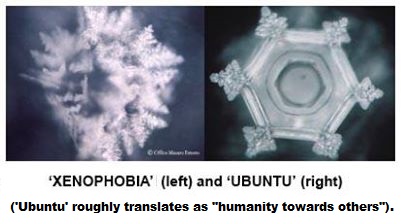
All energy has its own frequency which is the rate in which the energy vibrates. It’s a proven fact that ‘negative’ energy vibrates at a much lower frequency than ‘positive’ energy. As seen in the water molecule experiment, Love has the highest vibration of all and creates sacred geometry when Love energy is directed at the water molecule.

Human beings are also made of energy and our energy is our very Life-source, because our bodies couldn’t function without energy. By volume, the human body produces 60,000 times as much luminosity per cubic centimeter as the Sun, which makes human beings quite radiant indeed!

tumblr_n1s5725cJQ1s1vn29o3_1280

Word Vibrations and their Effect on Water 2

The simplistic thing about emotional energy is that there are only 2 emotions from which all other emotions stem – they are either Love or fear. Obviously fear is negative and Love is Positive, and we can visually see the difference. This means that if there is negative energy directed at a person, society, religion, or social class then we are all effected in some way through labels and judgment or the “ego”, which is a service-to-self mentality. And the opposite can be said for positive energy.

Mental Slavery of the 99%

At this point we should all be familiar with the “elite” or “the 1%”, who hold the majority of the world’s wealth and prosperity. According to an article in Forbes Magazine, almost half of the world’s wealth is owned by just one percent of the population.  

The fact that there is a global elite in the first place suggests an imbalance. If we live in a “Freewill” Universe then how is it that we can be so trapped and confined within a system where we allow a select few to speak for the masses? This also implies imbalance because most of us don’t remember having a choice in whether or not to participate in the system from Birth. The elitist system is based on conditions, rules, structure, labels, and limitation which encourages and expects society to create a self-manufactured image of perfection in order to feed the 1%.  

If we can find a way to empty our cup of all we think we know, we can re-assess the situation from a higher perspective. The system runs on the fear, stress, trauma, and negative energy of its participants. It’s imperative to begin to free the mind from the propaganda that is programmed to keep society on a short leash, by giving our power away to the governments, media, doctors, banks, corporations, and pharmaceutical companies.  

Like the “Wizard of Oz” there is a proverbial “man behind the curtain” who is pulling the puppet strings of the few tomanipulate the many.

“Mental slavery is the worst form of slavery. It give you the illusion of freedom, makes you trust, love and defend your oppressor, while making an enemy of those who are trying to free you or open your eyes” ~ Eli

I recently watched the Hollywood movie “12 Years a Slave” which is based on the book written by Solomon Northrup. It’s the true story of how he was taken as a free man and forced into slavery for 12 years. Solomon Northrup had already known Freedom but other slaves that had been born into slavery couldn’t be convinced that they were indeed “slaves”. This raises the question of how would we know that we don’t know in the first place? Furthermore, if we are born into an invisible slavery system based on a prison of fear and negativity, how would we be able to recognize it if it’s all we know and all our parents know? Especially if our parents and their parents perpetuated the fear based mentality by passing it down from generation to generation?

Harriet Tubman quote on slavery

Fear is the most negative energy that exists in its vibration and the most “hateful” thing we can do to one another is encouraging one another to be fearful or inflicting pain because of our belief systems. By keeping the general population in fear, we feel “threatened” whether we realize it or not. And as a matter of fact the U.S. has been in a declared “State of Emergency” since 1933, which has the intention of fear. This fear leaves us in a constant state of stress, in the fight or flight reaction it brings, thus leaving the Soul to quietly be consumed by the unhealthy emotions that fear brings — in its many forms.

Energy, Power, Wealth and Resources

In stark contrast, the supportive Universe is teeming with Life and is Limitless and Infinite by its very nature. The point being that if we are supporting an “elitist” system the Universe is also supporting this system as we Live in a supportive Universe. It’s quite obvious that the “elite” feel that they are entitled to resources including energy, water, and financial wealth — but where does that leave the rest of the 99%? I don’t know who decided that they were in charge of auctioning off resources that belong to ALL of Humanity’s children. As a child of my Creator, it is quite logical and apparent to me that I don’t have to “earn” my right to be here in the first place, and I certainly shouldn’t have to pay or fight for resources that are for ALL of us and not just a select few.

All-people-everywhere-should-have-free-energy-sources-Electric-Power-is-everywhere-present-in-unlimited-quantities-and-can-drive-the-worlds-machinery-without-the-need-for-coal-oil-or-gas

When we support an elitist agenda we are in fact enabling ourselves to give our Power away to some sort of “authority figure”, and think that said authority figure is going to come to the rescue when times get tough. As many are finding out, this is not going to happen. The scary part is that the agenda has never been in favor of the masses but yet we support it anyway and, not only that, we teach our children to support it. This inadvertently leaves behind a legacy that cannot sustain itself or our planet, which is also consumed by our “negativity” in a physical and spiritual way.

Energy and Resources

Energy is an important factor in this discussion, especially when one takes into account that Free Energy Technology has existed for quite some time. For those who are still skeptical of this, please check out the open sourced documents for a quantum energy generator and this short clip of the Quantum Energy Generator reaching resonance for the first time in the One People Community Aouchtam workshop. 

https://www.youtube.com/watch?v=_7–G5qSDag

Fossil fuel and the petro-dollar are the cornerstone of our enslavement as this gives the “elite” all the excuse they need toinvade countries for their resources under the guise of “terrorism”. With a select few “stealing” energy from the masses by way of fossil fuel when there are cleaner and better ways, we can begin to see how the global resources have been manipulated to line the pockets of the few while leaving the masses in poverty, illness, homelessness, and hunger.

The mainstream media is owned by corporate conglomerates who, like oil tycoons the Koch Brothers, buy the way for their agendas to make it into law and governance, and decide whether or not to report their dealings on the “news”. 

Health Care

This is also true for the pharmaceutical companies in that they do not promote Healing or Wellness rather they invent illness so they can profit from treating the symptoms but typically not the root cause. 

Have you ever noticed how doctors know exactly what surgery to perform or exactly what drug to prescribe which only treats the symptoms but rarely the root cause of the illness? It’s baffling that insurance companies refuse to pay for more holistic treatments and approaches to Healing in general. There’s plenty of “illness” to go around these days too, if we also include psychology, trauma (PTSD), addiction, and depression. But there’s no time or financial resource spent on Healing. There’s always a pill and an “instant gratification” solution so that you can buck up and get back to work, or jump through hoops to maintain an economic solution when one is unable to “earn a living”.

There’s a great documentary called “Escape Fire: The Fight to Rescue American Healthcare” which is a must-see if one is questioning the state of Healthcare in the U.S. (or comparable economies). To learn more, visit the Escape Fire website, watchthe movie trailer, or support the film-makers and pick up a copy on DVD.

The War Machine

The war machine is what the “elite” agenda relies upon to keep the populace in fear and terror, while keeping them in control of finance and resources. There is no Love in war and no one ever “wins”, as is evident by the “war weariness” that has captured the Hearts and minds of the masses. Yet, we find ourselves on the edge of our seat waiting for the next excuse to invade a country rich in resources or another who is considering putting an end to the fiat dollar in the best interests of Humanity.

An Era of Corporate Rule

There was a very important Supreme Court decision in the Hobby Lobby case that will give more “proof” that the agenda of modern government is one-sided; Corporations, by law, have the same rights as Individuals. This means that we have a Government that is for The Corporate, and not a Government that is Of The People, By The People, and For The People as stated in the Constitution — which therefore violates our Constitutional Right to Life, Liberty, and the pursuit of Happiness. Meanwhile, our Senators and Congresspeople argue over Corporate interests.

arundhati roy quote - corporate revolution will collapse if we refuse to buy what they are selling..

And this was also in our face lately, in regards to the recent Supreme Court decision McCutcheon v. FEC. Quoted fromMoveToAmend.org:

On January 21, 2010, with its ruling in Citizens United v. Federal Election Commission, the Supreme Court ruled that corporations are persons, entitled by the U.S. Constitution to buy elections and run our government. Human beings are people; corporations are legal fictions.

We, the People of the United States of America, reject the U.S. Supreme Court’s ruling in Citizens Unitedand other related cases, and move to amend our Constitution to firmly establish that money is not speech, and that human beings, not corporations, are persons entitled to constitutional rights.

The Supreme Court is misguided in principle, and wrong on the law. In a democracy, the people rule.

WE MOVE TO AMEND.

Click here to sign the ‘Move To Amend’ Petition. This is important because, in the words of Supreme Court Justice Stevens (January 2010)…

… corporations have no consciences, no beliefs, no feelings, no thoughts, no desires. Corporations help structure and facilitate the activities of human beings, to be sure, and their ‘personhood’ often serves as a useful legal fiction. But they are not themselves members of “We the People” by whom and for whom our Constitution was established.

The Role of Organized Religion

Christianity and other “religion” teach us that there is a judgmental “God” who sacrificed his son in order to save us from our “sins”. This is unhealthy and another way we give our energy away to those we perceive as being “above” us in some way, and perceive our humanity to be inherently “sinful”. It teaches us that we/they can do whatever we want to each other and the planet (sin) without consequence, when the Universal Law of Polarity states that there is Cause and Effect to everything.

The true teachings of Jesus speak of the Power we have by way of the Law of Attraction to Create our reality — and this is what we do everyday by continuing to sell our Soul to a select few while our children are dying in war, famine, emotional trauma, and poverty.

There is no judgment or condition in the Real emotion of Love and it is Christ Consciousness that must return to us from withIN, in taking back the Power we have chosen to give away by “default”. There is no “messiah” rather there is “us” and we are the ones we have been waiting for. It takes a great deal of Faith to decide to no longer support the flawed system of limitation (including religion) that we have allowed to rule us in an Infinite, Intelligent, Loving, Abundant Universe.

As Above, So Below…

The Law of Correspondence (Immutable): The second of the seven Universal Laws tells us “As above, so below; as below, so above” ~ Tania Kotsos

This means that there is “harmony, agreement and correspondence” between the physical, mental and spiritual realms. There is no separation since everything in the Universe, including you, originates from the One Source. The same pattern is expressed on all planes of existence from the smallest electron to the largest star and vice versa. All is One.

The Ancient Greek Temple of Apollo at Delphi refers to this great Law of Correspondence in the inscription “Know thyself and thou shalt know all the mysteries of the gods and the Universe”. This means that what we inflict on others by way of our limited perspective of what we are “told” vs. the Truth is the same as hurting ourselves because we are all Connected. As above, so below.

The Truth is that we can no longer excuse ourselves with denial in order to leave behind a Legacy for our children that includes a planet in which to live on. We have to begin to make our government, financial system, big pharma, and corporationsaccountable for their actions; by not doing so we are enabling our own demise, much like an insecure victim, enabling our addiction to this incredibly flawed perception of “Freedom”, which actually teaches reliance instead.

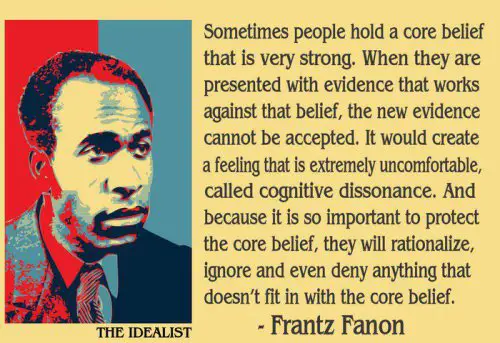
Frantz Fanon - The Idealist - Cognitive Dissonance

Unity and Oneness

Working with others involving emotional trauma, it recently occurred to me that it is much more difficult to Heal the hurt of misunderstanding the misuse of energy and the power we have given away on a personal level. But it is possible.

Each individual is different but our experiences speak of Unity and ONEness. If we can Awaken ourselves to the societal issues without throwing our hands up in denial and powerlessness, we can begin to find our Spirituality again through this Freedom. If we can embrace our Power as “the masses” we can begin to support a New system of Free Energy and responsible governance, especially when it comes to financing the few.

In an Infinitely supportive Universe, we can begin to Live and Thrive through the Healing of the planet and the “trauma” we have endured together while we were “sleeping”. We can shed our self-manufactured image of perfection in order towork through the process of RE-building something that is in favor of the 99% of US, the Human Race. A supportive “God” (Universe) is a LOVING force of energy that wants what WE want and will support us in Limitless ways.

I believe that Free Energy Technology is the first of many waves of our “liberation” and it’s now being distributed Freely via the internet and social media. From here, there will be no more stealing of energy via fossil fuels, war, money mongering, and keeping the masses in fear. When we realize that our energy has been Free all along, we will see that the most important things are also Free, like a Loving Universe and the Human Connection of ONEness.

It starts with each and every ONE of us by RE-focusing OUR energy on more and more productive ways to shift our reality to ONE that is for the Greater Good of Planet Earth=Heart and her Creatively Intelligent children, the Human Race.

About Blueprints for Butterflies:

Jennifer Deisher is the writer of the Moon Hippie Mystic blog and Co-Founder of Blueprints For Butterflies with her husband, Aaron Deisher.  Blueprints For Butterflies was founded as a safe, loving space to assist and heal others who are Awakening and making a spiritual connection with their Higher Self.  This creates a spiritual, emotional, and creative blueprint that leads to greater peace, awareness, love, prosperity, and enlightenment.  To book a private healing session and/or reading with Jennifer & Aaron Deisher, please visit BlueprintsForButterflies.com or contact us atBlueprintsforbutterflies@gmail.com.  References available upon request.

AaronAaron deisher has studied and practiced aspects of shamanism and earth medicine for over 25 years. His gift of logic and compassion provides an authentic connection with spirit and the universal field of consciousness. Aaron specializes in the art of human relationships furthering his ability to interpret and translate energy signatures and auric fields . He gently brings darkness to light by identifying and assisting with the release of stale energy.   To book a private session, please visit BlueprintsForButterflies.com, click here or e-mail us at Blueprintsforbutterflies@gmail.com.  References available upon request.

Copyright © The Moon Hippie Mystic.  All rights reserved.  You may copy and distribute this material as long as you do not alter it in any way, the content remains complete and you include this copyright notice.

 
Attachments area
Preview YouTube video QEG Resonance in Morocco – OPC: Aouchtam 04/28/14

QEG Resonance in Morocco – OPC: Aouchtam 04/28/14

WOMEN AND NATIONAL DEFENSE: CHALLENGES, TRIUMPHS AND MALE RESPONSE

Dr. Raj Kumari Singh

Prof. & Head, B.Ed. Department, IFTM University, Lodhipur Rajput, Delhi Road, Moradabad- 244002

 Abstract:

The present study has been focused on the induction of women in the armed forces which has been highly skewed and shallow. This has been based on an issue that critically affects the fighting potential of the armed forces, providing fundamental right of equality of sexes and also leading to women’s liberation. Many ill-informed observers have trifled such a sensitive matter by terming it as ‘conquering the last male bastion’. This is an issue of great contradiction where many stances have been taken more on the basis of personal views and mind-sets rather than on well evolved logic. The women have always been considered to be subordinate to men in every society of world. For Starting, this issue needs to be stressed that the services carry no male chauvinistic mindset. This is well known fact that fact that daughters of our country have excelled in all fields from the times immemorial and that higher class persons do not suffer from any gender bias and are very supportive of women’s advancement. However, the issue of women’s induction in the services warrants singular treatment. However, there are also the instances of narrow mindsets for the induction of women in armed forces. In the recent past, everyone was shocked on hearing a retired senior Army officer who recommended the constitution of all women battalions in the Indian Army. There cannot be a more preposterous and perilous proposition. Many organizations including various industries and large companies do not show gender bias in this age of development. Often we go across the news of hearing a number of American women soldiers fighting in war in Iraq and Afghanistan fights against militants. This is not equally true and acceptable in India’s stance against allowing women to join armed forces. The present study is an endeavour to remove some common misconceptions and put all issues in their proper perspective.

Key words: National defense, women rights, equality, harassment, social status ets.

Economic Role of Rural Women in comparison to the Fewer Education Opportunities.

Priyadarshini Kiran

Teaching Associate, College Of Journalism and Mass Communication, Teerthanker Mahaveer University

Abstract:

Woman education assumes significances from the point of view of enabling them to efficiently participate in the developmental process as well as in changing their subjected position in society. However, the present scenario does not satisfy the statement mainly in rural India.

“I start my Paper with the famous quote by Nobel Prize winner Malala Yusuf “One Child, One teacher, one book and one pen can change the world. With this motivating line. I grab my research objective to enlighten the scenario of women education in rural India. Education is a powerful word that has capacity to transform the world, which even a weapon can’t. India is a country with different flavors of soils and having 75 % rural area. According to Infochangeindia in India, we have a total women population of 49,48,28,644 and out of this 359817177 are of rural India and rest 135011467 belong to urban areas. Rural women have not bound themselves to limited infrastructure scenario as is perceived from the contribution of women economically in country where 31 % rural women and only 11.5 % urban women are the change makers according to the report of World Bank. This research paper is an attempt to examine partial role of government to serve uplift education in rural India in Comparison to urban area. This research Paper also focuses on Women Economical participation of rural area v/s urban area. If economic participation of women in rural area is more than urban area then why the government fails to implement and motivate the ratio of literacy in rural India.  This paper also highlights the need of feminist participants for understanding the actual position of education in India.

Key Words: Economic Participation, Education, Literacy, Rural India, Rural Women, Urban Women.