An Insight of Executive-Legislature Relations in Bangladesh

Jannatul Ferdous

Lecturer, Department of Public Administration

Comilla University, Bangladesh

 A book review of “Dominant Executive and Dormant Legislature: Executive-Legislature Relations in Bangladesh” (Second Edition), by Mohammad Mohabbat Khan, published by A H Development Publishing House, Dhaka 2014, pp. 131, Price: Taka 500. ISBN: 978-984-91036-5-3


Legislative, executive, and judiciary: the three separate branches of government that is shared between. Each branch is independent of a separate function, and cannot usurp the functions of the other branches. However, branches are interrelated. They work together with each other, and also inhibit each other from endeavoring to adopt excessively ample supremacy.

This correlation is entitled as the principle of “checks and balances,” wherever the tasks of one branch assist to encompass and adjust the influence of the other. The framers of the constitution pursue to shield the country in contradiction of autocracy by this instrument. A deeper inspection of the Bangladesh constitution’s provisions shall make clear understanding that, in a real sense, the principle of “check and balance” devises been overlooked in the constitution. This, in its current form, only confirms the “ascendancy” in its place of “check and balance” of the executive control over the legislature.

Not very long ago, the legislative-executive relations literature was bisected. This exchange between the two, with very little work has evolved into two separate and independent bodies. A branch concentrated on parliamentary systems and the other focused on presidential systems, which remained deliberated to epitomize two entirely self-determining and unconventional means to shape the party-political sphere. That is the understanding about any of these systems had slight or certainly not any influence on whatever we got knowledge about the other. Each system was thought to have its own principles, from which there working possibly will be entirely assumed; and these ideologies just keen to infinitely diverse inducements for and, thus deeds by, political players. The doctrines of parliamentary and presidential system require doing, obviously, with the dependency or independency of the executive order by way of respect to the legislature. While parliamentary system is regarded as by a system of “reciprocal dependency,” and presidential system is regarded as by a system of “reciprocal independence”. This fundamental dissimilarity was taken to define together the nature of the correlation concerning the executive and the legislative authorities, and whether this correlation would be restricted to the boundaries enforced through the constitution: assistance and constitutional boundaries in the methods defined by reciprocal dependency; clash and extra-constitutional conduct in the systems well-defined by reciprocal individuality. The executive and the legislature, all together, were considered as integrated performers, challenging for impact over policy results. It is probable to say that nowadays in democratic regimes there present a more assimilated opinion of executive-legislative relations.

The present parliamentary practice of government in Bangladesh is embedded in the 1972 Constitution. There assimilated provisions were in the Constitution of Bangladesh with the purpose of creating the organization totally independent. Though, in 1972 the Constitution delivered a possibility, which redirected the distrust prevailing in the political ground. A member of the Parliament would evacuate his seat if he backed in contradiction of the party that voted him; Article 70 of the constitution specified that. It is mocking that the very political party which tried to institute the Parliament such as the ultimate law, constructing figure in the repercussion of the liberation War, far along took necessary steps to restrain its power with the starter and passing the bill on January 25, 1975 of the 4th amendment of the Constitution which makes instantaneously converted the parliamentary structure into a one party pillar. The Parliament then turns into to a certain extent unproductive and rotated into a consenting instrument in the influence of the President. All Executive, Legislative and Judicial powers were concentrated in the hand of the President.

The “New Start” poised on the brink, but the government was overthrown by a military coup. From then until 1990, Bangladesh is a semi-parliamentary form of the package went through the authoritarian era. Bring back the restoration of democracy in 1991, the Government of Bangladesh Parliament. 12 amendments introduced the concept of the sovereign Parliament. The Constitution was enacted in 1972, the politicians and ministers of the cabinet, which is the responsibility of the joint responsibility to ensure that both were willing to set up an effective parliamentary system. In line with this vision, the methods used to enforce the rules of the accountability process, providing a detailed guideline. However, the political changes during 1975- 1990 the Parliament failed to fulfill this vision in such a way that led to the amendment of the Constitution. Introduced the concept of parliamentary democracy, although after the 12th amendments, the controversial article in the constitution to remain in doubt whether the presence of the Parliament allowed to practice.

We have already seen an image of this throughout the term of the previous four elected government bodies, where the Prime Minister, the cabinet and the bureaucracy introduced a huge quantity of bills. Executive ascendancy is diligently linked to the authority and position of the post called Chief Executive, specifically, the Prime Minister. Actually, the transference from the presidential form of Government to parliamentary form of government takes to a large degree simply predestined the transference of the complete power from the President’s hand to the Prime Minister. The 12th amendment of the Constitution has been strictly analyzed as it permitted an imperfect alteration from a presidential form to a parliamentary form of government. The post of the Prime Minister as reestablishment of democracy has developed tremendously dominant. Parliamentary accountability mechanisms have also failed to work properly and key policy assessments are taken several times outside of the Parliament. They very also rarely talk over in the Parliament.

The necessary prerequisite of an operational Parliament is to checking Executive dominance, keeping regime continuance, constructing up the harmony amongst the political parties and so on. Both formal and informal ways of executive authority has persisted – with harmful results for the country as a result of unproductive parliament. First, it backs to the ruling parties and the opposition party did not take into account. Second, deficiency of control on Executive role turned the role of the legislators dictatorial. Third, policy decisions were taken by the cabinet and the politicians failed to interpret the law properly. Fourth, this Executive dominance culminated in deep political tension where the opposition clearly exhibited their disinterest in joining parliamentary meetings. Lastly, an unproductive parliamentary government give the opportunity of undue influence on policy decisions has allowed donors.

The book under review is written by Professor Mohammad Mohabbat Khan, emphases on the lack of supremacy of the legislature in Bangladesh, that resulting ascendancy of the executive.  This is principally as a consequence of ineffective and lower position of the legislature vis-a-vis the executive. The executive is playing a dominating role and the legislature is dormant in Bangladesh. There are a number of causes of this state of doings.  These are included executive regulations on the legislative program, the particularly authoritative standing of the prime minister, insufficient discussion on policy. Some variations are recommended in this book to overcome the issue of the executive dominance over the legislature. These changes are: modifications in the approaches of the political leaders, consolidation of the parliamentary committees, active and well-organized research on the parliament, formation of organization of the Ombudsman and essential variations in the procedures.

The book tracks an organized and classy exploration idea to ensure fairness to this significant extent. Various chapters of this book have been organized theme wise to deliver a perfect image to bookworms and forthcoming academics. The practice of Bangladesh obviously demonstrates the style and degree of ascendancy of the legislatures by the executives.

The book is divided into eleven chapters. More definitely, in chapter 1 the author presents his idea of study, stipulating characteristically the study aims and objectives, together with the organizational preparation of his book. Chapter 2 encompasses debates on such thoughts such as constitution, executive, legislature, and governance pertinent to the working of the parliamentary government in all-purpose. Chapter 3 inspects the basic features and extents of executive-legislature affairs sketch profoundly on the practices of parliamentary systems functioning in the England and other European states. Chapter four is considered as a relating chapter. At this point, the aim is to analysis the nature of the legislative-executive relations throughout the colonial rule of the era of the British and Pakistan. This chapter is vital as it delivers historical development of in relation between the two organs of the rule. Chapter five investigates the features of legislature-executive affairs between 1972 and 1990. This chapter is preceded by a transitory argument of political progresses in Bangladesh since the initial ties of liberation to early ’90s. Chapter six contains a conversation of parliamentary elections of 1991, initiating of Khaleda Zia regime to deliver an experience for succeeding exploration of legislature-executive relations throughout 1991- 1996 concentrating on such significant variables such as constitutional modifications, executive domination, confines to government domination, anticipatory role of the opposition party and the part of government backbenchers. Chapter seven defines and examines the nature, aspect and distinctions of legislature-executive affairs throughout the rule of the second regime of Awami League government that approached to rule in mid-1996 and accomplished its five- year tenure in mid-2001. The variables investigated in this chapter contain executive domination, confines of government domination active part of the opposition party and the part of government backbenchers. Chapter 8 encompasses studies of the dated concerning 2001 and 2005 that in operation get into the light the existing and shifting executive-legislative relations under the BNP-led four-party alliance government. In this chapter, the construction and working of the third caretaker government and the 2001 parliamentary elections are also deliberated. Chapter 9 describes the radical disorder and proclamation of control by military assisted caretaker government that acquired place afterward the exit of BNP led government in the last portion of 2006. This chapter besides deliberates how the executive ran the country in the absenteeism of the legislature. Chapter ten delivers the reader through the study of the executive – legislature relation throughout the period of 9th parliament. The 9th parliamentary elections were inescapable to renovate democratic status in Bangladesh.

The previous caretaker government prepared the 9th parliamentary elections and all main political parties contested in that election. Chapter eleven encompasses clarifications refer to executive-legislature relationships in Bangladesh. It besides suggestions policy prescriptions carry about equilibrium in the relationships concerning the two branches of government. The recommendations of the author’s that identify methods in the direction of the aim of strengthening the position of parliament in Bangladesh, however, it would definitely be tough to get rid of them in total. He deserves praise for his meticulous determinations to assemble and organize all pertinent data, scrutinize them systematically and show disapprovals in anyplace required.

In 2006, the book was first published by South Asian Publishers, Delhi and A H Development Publishing House, Dhaka together. Subsequently then, seven years have passed and some significant expansions have taken place relating to executive-legislature relations in Bangladesh. The current edition covers the up-to-date facts concerning the executive – legislature relations in Bangladesh. Such progresses contain postulation of control by a military supported caretaker government and holding of the 9th parliamentary elections.

Generally speaking, the book is very much instructive and informative. It makes an appreciated impact to the prevailing understanding about Bangladesh’s parliamentary form of government in its constitution, organizational and practical frameworks. The book gives an insightful picture of the evolution and progress of parliamentary form of government in Bangladesh. This book was knowledgeable to the teachers, students and researchers in the past, present and future as well. This book possibly will be a perfect guideline for the political leaders to establish a vision to create the forthcoming of the country, optimistic and make potential modifications in the governmental system. It is definitely an appreciated book accessible now at the prominent bookstores in Dhaka city.


India Iran Relations during UPA 1st and 2nd (Mutual Cooperation, Constraints and Challenges)

Sajad Ahmad Mir

Research scholar in school of social sciences Department of political science DAVV Indore (M.P) India

Abstract:

India and Iran- the great civilizations of the world had close historical, cultural ties and linguistic and religious links for centuries. The end of the cold war in 1990s had given India a chance and traceableness to carry out its foreign policy in the region. Relations between them have been deepening with respect to the most issues, especially security, energy and transportation. The relations between the two have seen twists and turns in history where they have been close at times and share common interests. Iran holds a particular importance for India as it provides unique access to Afghanistan and Central Asia, but at the same time there are several constraints that restrict India’s reach into Iran. This article examines the key areas on which both countries can cooperate to strength their relations but at the same time, examines the factors that hinder their relationship.

Keywords: besieged, Chabahar, consultations, G-15, Gulf Cooperation Council, interest, nuclear, Syria,

The Influence of Organization Culture on Employee Readiness for Organizational Change

*Anthony Andrew;**S. Mohankumar;

*Senior Lecturer, Department of Management, Eastern University, Sri Lanka. 

**Assistant Professor, Department of Business Administration, Annamalai University, India

Abstract

The survival of living being in the globe is importantly depend on the existence of organizations.Every organization in the world today has to abide by the ever increasing intense competitive global business conditions. Modern organizations in the business world today have to prepare themselves to face high competition, make quick decisions, introduce innovations and develop the will and competency to cope with constant change (D’Aveni, 1998, p. 183). Today, the ability of an organization to change drives its growth (Vakola, 2013, p. 96). Successful, organizations must be responsive to the needs of constantly evolving business environment (Leana&Barry, 2000, p. 754).The environment in which Organizations operate is increasingly critical and dynamic in nature. Due to increasingly critical and dynamic environment, organizations are continuously forced with the need to implement changes in strategy, structure, process, policies, operations, technology, and culture.


The principal constraint in implementing a change process is the resistance from employees. Recent interest in academics to study and understand the attitudes of employees’ towards change has been growing (Rafferty et al., 2013 p. 112; Caldwell, 2009, p. 20). One of the most discussed notions in organizational change is change readiness. It refers to employees` attitude towards a change initiative (Rafferty et. al., 2013, p. 121). One of the first scholars to discuss change readiness is Armenakis, and the most influential and referred to work about change readiness is by Armenakis et al. (1993) and Armenakis& Harris (2002).


The aim of this study was to examine the relationship between organizational culture and employee readiness for organizational change. The objectives were to investigate organizational culture and identify the influence of organizational culture on employee readiness for organizational change in Divisional Secretariat, Eravurpatru in Batticaloa District where various change reforms has been introduced recent past. This empirical study proceeded by a systematic review of literature that led to development of a conceptual model. The data was collected from a sample of 100 Employee from Divisional Secretariat, Eravurpatru in Batticaloa district by using a survey questionnaire. Data was analyzed using descriptive statistics. Results showed that organizational culture was positively and significantly correlated to employee readiness for organizational change. This study provides empirical evidence for employee readiness predictor variables for organizational change and may contribute to strengthen the literature on change management, particularly for Sri Lanka, and may assist the management, change agents and practitioners of human resources management to shape the organizational environment in assessing, designing, introducing and evaluating new or existing programmes for organizational change.

Customer Relation Management

Priya Malik

Assistant Professor, G.M.N. College, Ambala Cantt.

ABSTRACT

To understand the relations maintained by various Companies with its customers. Ever increasing competition, low interest rates, and declining margins have driven firms to discover the customer as the basic element in their business equation Insurance as a sector has shown tremendous growth in recent years. People now are becoming more secured in terms of their life as well as their money. They want a profitable benefit out of their investment. There is a need to know the companies’ efforts towards convincing the customer about their product and to know how to create loyal customers. Insurance happens to be a mega opportunity in India. It’s a business growing at the rate of 15-20 per cent annually and presently is of the order of Rs 450 billion.

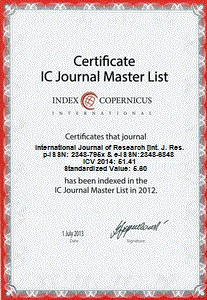
International Journal of Research in Index Copernicus

We are happy to announce that our International Journal of Research got indexed in Index Copernicus Database for quality publication done over last few years.

Hope to see the co-operation of our esteemed authors, research scholars, professors and other academicians in future too.

International Journal of Research [Int. J. Res.] p-ISSN:

2348-795x

e-ISSN:

2348-6848

ICV 2014: 51.41

Standardized Value: 5.60

Area: Technical science

Technical science

Social sciences

Humanities

Print version: yes
Electronic version: yes

You can submit your research papers for publication through following email id

 editor@edupediapublications.com

editor@internationaljournalofresearch.org 

Partition Theme in Chaman Nahal’s Azadi and Khushwant Singh’s Train to Pakistan

Dinesh Kumar

Asstt. Prof. of English, Dyal Singh College, Karnal

Abstract

Without any shadow of doubt, the theme of partition is one of the leading themes in Indo-Anglian fiction. There are number of Indian writers, males and females, Hindu as well as Muslims and even Sikh novelists who have contributed a great deal to the development of partition theme. Hindu novelists like Chaman Nahal, Manohar Malgonkar  and many more; Sikh novelists like Khushwant Singh, Raj Gil, H.S.Gill and K.S.Duggal whose contribution in noteworthy in the arena of partition fiction; and the contribution of Muslim novelists lie Attia Hussain is worthy of detailed consideration, all have their collective contribution in the field of partition theme.

Link to Access Full Paper

Pity and Responsibility in Graham Greene’s The Heart of the Matter

Dr Chung Chin-Yi
Research scholar, National University of Singapore

Abstract: It is thus because Scobie has a conscience that he experiences despair because he knows the gravity of his sin unlike the evil man who is without conscience and always has the hope that sin has no consequence, it is Scobie’s conscience as a man of faith that convinces him of his damnation because of his acute sense of guilt from sinning while the evil man is always convinced of his flawlessness and never experiences any sense of failure because he does not have a moral bearing or ideals which he holds dear to him or a capacity for something greater, so it is Scobie’s goodwill and conscience which damns him and convinces him that his adultery will never be absolved by God.
Keywords: Greene, Pity, Responsibility, Sin, Adultery, Suicide

Why […] do I love this place so much? Is it because here human nature hasn’t had time to disguise itself? Nobody here could ever talk about a heaven on earth. Heaven remained rigidly in its proper place on the other side of death, while on this side flourished the injustices, the cruelties, the meanness that elsewhere people so cleverly hushed up. Here you could love human beings nearly as God loved them, knowing the worst: you didn’t love a pose, a pretty dress, a sentiment artfully assumed.
Book 1, Part 1, ch 1, sect. 5
Scobie thus loves Sierra Leone for what it is in all its fallen-ness and mean-ness and imperfection. Heaven remains firmly on the other side of death while Sierra Leone was fallen, inadequate, imperfect, but which Scobie loved anyway because it was so honest and without pretense.
Against the beautiful and the clever and the successful, one can wage a pitiless war, but not against the unattractive: then the millstone weighs on the breast.
Book 1, Part 1, ch. 2, sect. 2
In this passage Scobie describes his feelings of pity and responsibility for his wife Louise, she is not perfect and she is unattractive, it is this unattractive nature of hers that stirs pity and responsibility in Scobie though he has long ceased loving her, he feels enough responsibility toward her to borrow money from Yusef to send her to South Africa after which he begins his doomed affair with Helen Rolt whom he falls in love with again out of pity because she is recently widowed and she reminds him of his daughter, eventually the sense of pity and responsibility towards both Helen Rolt and Louise will lead him to take his life as he cannot bring himself out of adultery and cannot bring himself to divorce Louise as it is a fatal sin for a Catholic like himself.
Despair is the price one pays for setting oneself an impossible aim. It is, one is told, the unforgivable sin, but it is a sin the corrupt or evil man never practises. He always has hope. He never reaches the freezing-point of knowing absolute failure. Only the man of goodwill carries always in his heart this capacity for damnation.
Book 1, Part 1, ch. 2, sect. 4
It is thus because Scobie has a conscience that he experiences despair because he knows the gravity of his sin unlike the evil man who is without conscience and always has the hope that sin has no consequence, it is Scobie’s conscience as a man of faith that convinces him of his damnation because of his acute sense of guilt from sinning while the evil man is always convinced of his flawlessness and never experiences any sense of failure because he does not have a moral bearing or ideals which he holds dear to him or a capacity for something greater, so it is Scobie’s goodwill and conscience which damns him and convinces him that his adultery will never be absolved by God.
The truth, he thought, has never been of any real value to any human being – it is a symbol for mathematicians and the philosophers to pursue. In human relations kindness and lies are worth a thousand truths.
Book 1, Part 1, ch. 2, sect. 4
It is thus Scobie’s kindness towards others as towards Louise he wishes to spare her from the truth that he no longer loves her, as he wishes to spare Helen Rolt from the truth that he cannot bring himself to divorce Louise and start again with her because it is a fatal sin for him as a Catholic to divorce. Thus he is entrapped in a deepening web of lies from which only suicide can set him free as his pity and responsibility towards both Louise and Helen Rolt makes it such that he cannot bring himself to hurt either or choose between the two and bring one of them to despair. He would rather sacrifice his own life like Christ than bring one of them to despair.
Point me out the happy man and I will point you out either extreme egotism, evil – or else an absolute ignorance.
Book 2, Part 1, ch. 1, sect. 3
Scobie thus rationalizes that it is only extreme egotism that convinces a man he is without sin and thus happy or absolute ignorance like the evil man who is without conscience and thus lives without awareness of his sin and a fear of damnation that comes out of the consequences of sin.

People talk about the courage of condemned men walking to the place of execution: sometimes it needs as much courage to walk with any kind of bearing towards another person’s habitual misery.
Book 2, Part 1, ch. 2, sect. 3
Again it is Scobie’s sense of pity and responsibility that leads him to view himself as a penitent savior for Louise and Helen Rolt’s misery, it is his sense of pity for Louise’s misery that makes him stay in the marriage, it is pity for Helen Rolt’s loneliness as a widow that leads him to begin his affair with her it takes courage on his part to constantly feel the need to engage and remove the misery of others from this terrible sense of pity he feels towards Louise and Helen Rolt.
“Pity smouldered like decay at his heart. He would never rid himself of it. He knew from experience how passion died away and how love went, but pity always stayed. Nothing ever diminished pity. The conditions of life nurtured it. There was only a single person in the world who was unpitiable, oneself.”
Book 2, Part 3, ch. 1, sect.
The fatal flaw of Scobie is thus pity, he cannot bring himself to rid himself of pity towards Helen Rolt and Louise and the accompanying sense of responsibility which comes with it with which he can only envision suicide as an escape because he cannot bear to let either woman down.
He whispered, ‘Oh God, I have deserted you. Do not desert me.’
Book 2, Part 3, ch. 1, sect. 1
Scobie thus feels a terrible sense of guilt from his adultery and feels that he has deserted God but feels in turn that God might not desert him out of the same kind of pity he demonstrates towards Louise and Helen Rolt.
God can wait, he thought: how can one love God at the expense of one of his creatures? Would a woman accept the love for which a child had to be sacrificed?
Book 2, Part 3, ch. 1, sect. 3
Scobie thus rationalizes his sin of adultery – God would not allow him to love him at the expense of Helen Rolt like a mother loves a child to be sacrificed, this is again a terrible rationalization of his adultery just like he rationalized Christ’s atoning death was a suicide to comfort himself of committing the mortal sin of suicide.
He entered the territory of lies without a passport for return.
Book 2, Part 3, ch. 2, sect. 1
Scobie is caught between two women whom he feels a deep sense of pity and responsibility towards and finds himself tangled in lies which he cannot absolve himself of and thus sees the need to escape the life of lies and acting through his suicide.
One must be reasonable, he told himself, and recognize that despair doesn’t last (is that true?), that love doesn’t last (but isn’t that the very reason that despair does?)[…]
Book 3, Part 1, ch. 2, sect. 2
Scobie again tries to rationalize that his despair towards offending God with his adultery will not last as love does not last either. Perhaps despair lasts only because love does not, because love towards a fellow human being is transient while despair towards separation from God is eternal.
You can look after yourself. You survive the cross every day. You can only suffer. You can never be lost. Admit that you must come second to these others.’ And myself, he thought, […] I must come last.
Book 3, Part 1, ch. 2, sect. 2
Scobie rationalizes again that God can take care of himself from the crucifixions that occur to him daily and this somehow makes God in a subordinate position to sin.Clearly this is a nonsensical rationalization as was his rationalization that Christ’s death was a suicide to spare himself the guilt of his suicide.
Scobie thus commits suicide out of despair that he has let God down and that he wants to spare God from himself as well as the act that he cannot bring himself to let either Louise of Helen Rolt down. In the end Father Rank hints that though Scobie’s death was a suicide, his love of God that led him to commit suicide is what may eventually spare him from the wrath and damnation of God as it was a genuine desire to spare God from himself that leads him to kill himself.

Works cited:
Greene, Graham. The Heart of the Matter. Vintage, London. 2004.

Lifetime Hosting Plan

GET THE DEAL OF YOUR LIFE

Entrusting WebHostFace with your website you may feel secure about its future! Your commitment to us will help us invest in hardware and infrastructure that will offer a flawless eternal accommodation for your online projects!

Tired of paying renewal fees?

Benefit from our limited time offer and get an account that will be active forever! You get:

The Features of a Regular Hosting Plan

Constant Expert Technical Support

Top-Notch Hardware for Utmost Speed

No Hidden Charges and 30 Days Money-back Guarantee

Ready to get started?


Call for Papers

Dear Author,

We invite you to submit your manuscript(s) to editor@edupediapublications.com  for publication.

Our objective is to inform authors of the decision on their manuscript(s) within four weeks of submission. Following acceptance, a paper will normally be published in the current issue.

Guide to Authors and other details are available on our website;
Must Read Guidelines

International Journal of Research (ISSN 2348-6848)

Best regards,

Editor,

International Journal of Research


ISSN 2348-6848

The Impact of Economic Globalization on International Trade Trends in Developing Countries at the Beginning of Third Decade

Said Mohammad Karim

Department of Management and Economics, Faculty of Humanities and Social Sciences,

Koya University, University Park, Daniel Mitterrand Boulevard, Koya – Iraq

  • Introduction

Currently, the world is experiencing a new scientific revolution in information, communication, transportation and technological knowledge-intensive. This revolution has deepened the globalization of all aspects of economic life of the movement of goods, capital, services and skilled labor. It became the technological revolution and in particular its part informational pivotal role. With The emergence of the phenomenon of globalization, which is the current stage of development of international economic relations, properties, and not put forward a new theory or a new perspective to understand the mechanisms of this development, and is a composite concept basically means examining the nature of the developments that have taken place for the international relations of economic, social, cultural and political dimensions, which makes impact on the trends of this development in the future.In other words, this might consider to be characteristics of the modern capitalist system.This is taking shape at the beginning of the Nineteenth and Twentieth centuries, which prompted researchers to give up the use of the concept of system, which necessarily involves the mechanisms and rules are clear and specific. Interested in studying changes in the relations between the inside limbs, in favor of the concept of globalization, which seems more neutral in the phenomenon of the more obscure and at the same time. However, this neutrality does not hide faith dimension inherent in it and which threatens the countries that rejected extinction and extinction, especially developing countries .premise from which this search extent to which developing countries of economic globalization and trade liberalization and the acceleration of goods and services flows, are developing their current state countries can to engage in the international economic system.

  • Concept of Economic Globalization

The current stage known a group of radical changes in the global economic system, predicted for the beginning of a new economic system characterized by milestones and trends are different from those prevailing before. Hence, the world is controlled by two trends which are linked and that they were separate, namely, globalization and economic liberalization.These two trends already taken place in switching conditions, the formation of economic behavior, and become more attached to influential tracks international national economy, and so became a success and progress to the strength of nations and blocs measured, this is even linked to the extent of participation or involvement paths of these two directions towards globalization, which has become prevalent even more dominant force in the world today, it was not coincidence. The return of the dream that accompanied the individuals since ancient times, to expand the range, mobility and investment, transfer of wealth and profit open broader horizons, as a result is made possible of the change in the international system, and the decline in the concept of a centralized economy or router to be replaced by the concept of a market economy, and its adoption as a tool essential for development. This concept, which stretch in all directions, is seen to the world as a single market, and thus is represents and embodies a vision based for a large segment of the countries that were leading and defending the principles of a free economy, giving the private sector a leading role. This means the predominance of the ideology of the free economy, triumph of the market economy, market mechanisms, and political liberalism. Consequently, globalization of the economy and on the scope of each of the international economy began to spread to all levels of production, financing, technological, marketing and administrative (Kella, 2011).

By taking a comprehensive look at the global situation, it can be said that the world has become more essential than ever before, and that the economical differences have become more acute and severe than they used to be and that the global distribution of income has become less balanced and less fair, though there is a large gap dominant to the world, it is likely to represent a serious threat to the growth achieved and the continuous development in the future.

The advanced industrial countries, which have committed themselves to the principles of free economy and previously defended him and worked on the publication, these countries are driving the global developments and designed a way that suits them.Because at this stage they have methods and the elements, it has a vested interest and potential of circulation, published and approved by the largest possible number of countries. These countries have prepared themselves in advance, who beneficiaries and are supported by an engine with motive to activate economic their income and activate its institutions list by exploiting existing possibilities and opportunities in the world.

However, developing countries that suffer from significant transitional structural and social problems, in most of these countries are still grappling with and affected by the global developments accelerating. All of these forces and trends formed with each other at the current stage the process of transition of the new global economic system. Which must be closer to the analysis of its components as well as determine the characteristics and features to identify the transformations and challenges and issues that began determined in the field of international trade, monetary system, manufacturing transport technology, preservation of the environment and other (Avhild, 2007). At this stage no wonder to show several terms reflect the features of the current stage, and even the future experienced by the transition process towards the establishment of a new global economic system, such as the term globalization or constellation or inclusiveness.

  • Technological Revolution and the New International Division of Work

The troubles of the existence of the technological revolution and information with the increasing freedom of movement of goods international capital may help clearly on the interrelationship and overlap between the parts of the world and confirm the global markets.Drop the barrier of distances between countries, and create a new type of international division of labor, which is the process whereby industrial productivity between more than one country so that the distribution of the components of any final product manufacture in more than one place. Thus it is no longer the main support of strength, as the economic capability is natural resources,  which it has become the main foundation in that to own advantage or competitiveness in the international arena, and which revolve around the cost and price and productivity and quality and is what the depth of the trend towards interdependence.

The emergence of new patterns of division of labor were not known, where the traditional image of the international division of labor is to allocate some of the country’s raw materials and mining and food commodity and specialty other countries in industrial products, and the assumption was that the country is developing a comparative advantage in the first type, while developed countries have a comparative advantage in industrial goods (Diab, 2010).

This division is no longer in line with reality, and the issue here is not just a shift in the comparative advantages of industrial goods to some developing countries, but what caused the technological revolution of the availability of new possibilities for specialization. This is due to the multiplicity of types of single products, for instance there is no one type of cars or radios or television or computer, but rather there are multiple types of needs and what type them in terms of production conditions may be different from what the other needs. Hence the division of labor between the different countries in the same products appears, and it has become fashionable, but mostly for a large number of consumer durables and machinery and equipment, that the same item appears in the list of exports and imports for the same country, this is known as the division of labor within a single industry.It has become fashionable to parcel one product among a number of the country’s production so that specializes every country in part or more, and this is known as the division of labor within a single product intra – firm.This kind has become of specialization of the most important aspects of the division of labor between the industrialized country and with each other, as well as in increasing cases between industrialized and developing the country.

Thus the decisions of production and investment become taken in accordance with considerations of economic rationalization in relation to cost and earning, even there has become an opportunity for many developing countries to penetrate the global market in a lot of products.Where new styles allow international division of labor to those countries gain competitive advantages in a wide circle of goods, and perhaps the experience of the Asian tigers in Southeast Asia, is the best example to that. The revolution in production was the occupation of knowledge of information relative importance of the first in the production process. Moreover, it is reflected in the emergence of new patterns of international division of labor, where the back of the division of labor within a single product intra – firm so that the distribution of the production of the various parts of a single item on the different countries of the world well be appear according to considerations of economic efficiency (Murray, 2013).

The new world economic system, which began to show its characteristics and features as well as is determined with the beginning of the nineties is still in the process of composition and formation conditions and compared to previous arrangements. It is noted that it uses new tools and methods to maximize the goals and objectives in line with the evolutionary stage – the stage of globalization – which reached and global changes that have taken place, and the new mechanisms that have arisen.Therefore, the dynamic characteristic of the new global economic system make sure day after day, as evidenced by the prospects for changing the balance of the existing economic powers on the basis of the future It is evidenced by the presence of more than one order of what will be the new world economic order in the atheist century the third millennium, some suggesting unipolar shape, some raised pyramidal shape, and othersuggesting parallel blocks shape.

  • Changes in the International Trading System at the End of Twentieth Century

The most important characteristic of a shift in the international trading system towards commercial freedom system after 1994 and the beginning of 1995 along with the establishment of the World Trade Organization – has included not only the liberalization of trade in industrial goods, but also included agricultural goods and other industrial goods such as textiles and clothing. This is in addition to the trade in services which is considered a turning point in international economic relations, and the liberalization of trade applied to services the principle of gradual liberalization and includes trade services, banking, insurance, capital market, transport of land maritime and air, contracting, tourism, telecommunications, and services such as professional technical consultancy and professional services offices. This encourages the phenomenon of labor migration or function instead of the labor force migration. In addition to the liberalization of services, it has included a shift in the international trading system, liberation organization, protection of literary, artistic property industrial, as well as liberalization of investment laws having impact on international trade restrictions.

The transformation of the internal orientation of any development strategy of import substitution to production for export is a result of the new trends of globalization and the great opportunities offered by the global market.This shift comes in particularly large number of developing countries. As a result, because the country has managed to developing high growth rates are achieved by the country has pursued a strategy of export-oriented development based on the exploitation of the potential of the global market to the greatest extent possible.

East Asia countries proved with a growing number of developing country success towards this direction. The international market can accommodate both availability which has the will to penetrate and it is important to complete the elements of export-oriented strategy, which works to promote the expansion of exports of products which features produced or can be produced present or future at relatively low cost compared to the rest of the other countries (Windsor, 2009). The export economy is a traditional long-term development process, is to put the pillars of transformation to be able to bring about changes restructuring in the economy, and that lead to the creation of diverse activities and sectors production structure uses the best technological methods, and earn exported products generally the ability to invade the world market. The strength become highly competitive, including corrects the position of developing countries in the patterns of specialization, and the international division of labor.

The profits from trade liberalization are not distributed evenly on the winners, both in industrialized nations or the developing countries. Hence, a according to the highest estimates is expected to be out collectively by more than 17 percent of the estimated increase in global income developing countries.The industrialized countries will get $ 100 million of the total expected in the world’s income as a result of partial liberalization of trade and of $ 119 billion which increases the share of the industrialized nations of the expected increase of up to 84 percent, and get developing countries to 10.3 percent. Despite those results, the importers of foodstuffs will be one of the most affected by trade liberalization, since the liberalization of trade in agricultural products, especially rice and oil, grain and wheat and uninstall support them by industrialized nations resulting in a rise in prices. On the other hand, it can be said that the distribution of gains attributable to developed countries obsessed by the global triad: the United States, Japan, and the European Union (Salih, 2006).

  • Nature of International Trade and Situation of Developing Countries at the Beginning of the Third Decade

Exchanges between developed and developing countries still in a large part subject to the international division of labor that prevailed after World War II. Accordingly, take it in the form of raw materials in exchange for industrial goods. Raw materials and for historical reasons  is an important part of the trade as well as developed countries providing the bulk of the trade of industrial goods in the world of the total exports of these countries towards the outside while the developing countries do not believe only a small percentage of the trade of raw materials in the world although it is part of the largest oil exports.Despite the fact that developing countries are the main source of raw but there are no raw materials in the industrialized countries and also exchange industrialized countries among them an initial goods. And some of these raw materials needed by countries of the South, and in general, a quarter of the value of exports of industrial countries to developing countries is equivalent to the value of all exports in the form of raw materials coming from these countries to the industrialized nations.International trade rolling is now a market of industrial goods. It can be conclude from this that the developed countries dominate the exports of all industrial goods and an important part of the raw materials we will review the exports of some of these products. However, this growth achieves significant differences between the various developing regions in addition to the contraction of world production growth.There are other factors behind the chill international trade such as the events that took place in the Middle East region, the changes in Eastern Europe, and declining terms of trade for developing countries rates (Salih, 2006).

On the other hand, the nineties identify the fast growth rate of international trade, and this is due in part to the rapid spread and flourishing trade in components of high-tech electronic goods. In spite of ongoing international trade, it grows faster than the speed of growth of total production. This is due mainly to the poor economic performance of developed countries. As regardless of an increase in global production, the rate of growth in developed countries has fallen as a result of the slowdown in production, which represents more than two-thirds of world production, and this is because of multiple factors, including the increase of public debt in most industrialized countries. Secondly, the growing pressure on European currencies as a result of deflationary monetary policies and their impact on exchange rates and interest rates. Finally, imbalances in the budgets of industrialized countries and that happened from the possibility of using fiscal policy as a catalyst for growth.

The beginning of the third decade has decrease in global production and international trade has reached lower global production rate levels since the eighties of the twentieth century, perhaps these reductions offered by global production and international trade through during this period returned mainly to the effects of the events of September 11, 2001, in the United States and that has touched most sectors in all regions with the exception of some Asian countries.

International trade continues to be a main driver behind the growth of the international economy, international trade and the growth rate is still in twice the growth rate of world output. The larger developing economies like China and India have seen continuous growth export activities. There are quite a number of developing countries made profits from the significant improvement in the terms of trade over the past few years, and due in large incision to the incident recovery in oil prices and some other commodity. On the other hand there are a number of oil-importing countries and exporting agricultural crops have been damaged from the terms of trade prevailing and suffered a loss, and in the light of high oil prices exceeded the proportion of the rise in prices exports of those countries as a result of the deterioration of commodity exports to those countries or for the two reasons together. Generally, the price of primary commodities has reached the top level and it is expected that many non-oil commodity prices are falling from the (United Nations report, 2005).

There is no doubt that the global economic changes that have evolved in the new world economic order will affect the developing countries, and that the global trinity economic and what raised from new issues in all areas reflect a new strategy aimed at pre-emptying the strategies most development self-reliant, such as those pursued by Japan and which star by the emergence of economic power to defy the developed countries such as Europe and America. This new strategy of developing countries pays adoptive development in the context of dependency of developed countries based on trade and foreign direct investment. That is why the developing countries adapt to what results this new trading system of the new patterns of international division of labor and toward greater economic interdependence.

 On the other hand, the investment and new issues on social paragraphs as measures of operating procedures, child labor … etc., are likely to act as an obstacle to humanitarian restructuring process. Under the trade agreement on the protection of intellectual property rights system is protecting the rights of the franchise strict and very accurate. Which may generate technological monopolies impede the transfer of technology on a global scale and that this will slow down the resettlement of industries operations. Moreover, the expectation of trade sanctions against countries that disturb the standards of work and child labor will give a significant adverse consequences for the transformation of the economies of low-wage and access to comparative advantages in the global market, and thus the new rules in the game of international trade and investment are likely to affect the recycling comparative advantage through cross-national companies and foreign direct investment process.

It is clear from all of the above, that the developing countries stand at a crossroads, choices are limited, either rejection. Therefore, isolation from the most important part and the most capable of the countries of the world, any part of the product of the progress of scientific and technological development, acceptance and as a result adapt to the international economic system that believes countries of the South that is uneven and unfair. For both options have to pay the price and the cost of each will be incurred (Zakey, 2000).

There are many who are interested in development affairs in the countries of the South incite rejection and call for an alternative think it is more useful to developing countries and their peoples, and is to increase the level of coordination and cooperation between these countries and clustering, if possible, to cope with the new realities in the global economy in order to modify or influence at least for the benefit of the South, and in spite of the theory of gravity for this option. However, the potential application of the facts to face many difficulties and obstacles, including economic limited capacity of the countries of the South in their current state, although it is under the South title meant a large group of countries a population of over 80% of the world’s population but they do not contribute to global income by more than about 20% and more than one billion people live below the poverty line as their share in making scientific development and technological progress modest negligible on a global level.

In addition to the low level of the will of the decision-making circles in these countries to develop the level of cooperation and coordination among them, in one hand to cope with the global economic system, on the other hand to cope with the global economic system. For developing countries to deal more rational and more open to the new economic variables, and working on extensive and comprehensive review of the development of its policies in preparation for the re-formulated in line and the new changes, and the development of economic mechanisms, including work contributes to better exploit the potential available and possible resources (Amin, 1997).

To conclude based from the above point, the new world economic order still needs to be repaired in its mechanisms and the functioning of its institutions, and reconsider the rules, whether in the field of trade, investment or other even it has the consent of the countries and the peoples of the developing world and the developed alike. It also notes that the new global trading system caused a sensation about his future, especially after widespread protest movements against globalization and its mechanisms.

  • Conclusions


  1. Developing countries in general face significant challenges may direct to gains, since if overcome, and could direct to losses if these countries unable to cope the changes.
  2. Reduce significantly the level of protection for the agricultural sector over the next few years, as it is also a most important sector in the economies of most developing countries that have a negative impact and unexpected results.
  3. These countries can draw its policy improvement and the development of their economies, especially with regard to the national production, which it is devoid of protection or low level of protection. There is no valid one answer for each of developing countries, and dealing with the issue of this importance vary from state to state depending on their circumstances and their potential.
  4. The abolition or reduction of subsidies for some products well weakens the competitiveness of developing countries in global markets.
  5. Progressive liberalization of services trade will lead to heightened competition in the global services market, and because of the weakness and fragility of the services sector in developing countries, especially the financial services activity of banks, insurance companies, Projections indicate that this sector may be affected negatively as a result of editing.
  6. The unit controls the commercial multi-density expansion parties and restricted the use of some selective economic policy that had a role in the success of the exports of developing countries tools, is no longer possible in light of the increasing liberalization in the international capital markets.The globalization of production of transnational corporations imposes legislation and laws on companies in relation to the objectives of the industrial policy of the host country. here it is emerge a conflict with the important role that practiced by governments in most developing countries, and especially industrial policies to accelerate structural transformation and strategic in the economy by supporting certain sectors identified as strategic to own comparative advantage kinetic potential task and receive so government support.

References:

  • Windsor, D. (2009.Globalization in the Atheist and the Twentieth Century – How Associative World? Emirates Centre for Strategic Studies and Research. Abu Dhabi.1st
  • Amin S. (1997).Clash of Civilizations or the Dialogue of Cultures. Al-Tathamn for publication. Abu Dhabi.1st
  • Kella, S. (2011). The Current Globalization – the Mechanics of Re-global Capitalist Style. Rand for Publishing and Distribution, Damascus. 3rd
  • Salih, Y. H.(2006). International Economic Relations. AlrwadAlmuzdahera Publication. Baghdad. 1st
  • Diab,M. (2010). International Trade In an Era of Globalization, Dar Manhal, Beirut. 1st
  • Afheld, H. (2007). Bestows Poorest Economy.World Knowledge Series, Kuwait.
  • Murray, W. (2013). Geographies of Globalization. World Knowledge Series, Kuwait.
  • Zakey, R. (2000).The Effects of Globalization and the Illusions of Running after a Mirage. Journal of Ala-Nahij. Vol. 57. Damascus.
  • United Nations Development Programme, the World Human Development Report (2005).