


How to Cite it
Surose, R. G., Tawade, R. V., Tejare, P., Patil, M., & Godi, S. (2026). A Review Conventional and Herbal medicine treating Brain-Eating Amoeba (Naegleria fowleri). International Journal of Research, 13(1), 219–224. https://doi.org/10.26643/rb.v118i12.13073
Miss Rutika Gopal Surose; Miss Rani Vinod Tawade; P. Tejare, Mr. Makarand Patil; *Dr Sandhya Godi
Abstract
The brain-eating amoeba, Naegleria fowleri, is a free-living, thermophilic protozoan responsible for Primary Amoebic Meningoencephalitis (PAM), a rare but rapidly fatal infection of the central nervous system. The organism is commonly found in warm freshwater environments and infects humans when contaminated water enters the nasal cavity. Following nasal entry, the amoeba migrates along the olfactory nerve to the brain, where it causes extensive inflammation, tissue necrosis, and cerebral edema. Clinical symptoms typically begin within one week of exposure and progress quickly from headache and fever to seizures, coma, and death. Diagnosis is challenging due to symptom overlap with bacterial meningitis and the rapid progression of the disease. Current treatment involves aggressive combination therapy using antifungal and ant parasitic drugs such as amphotericin B and miltefosine, along with intensive supportive care; however, the mortality rate remains above 95%. Preventive strategies, including proper water treatment and public awareness, are crucial in reducing infection risk. Continued research into early diagnostic methods and novel therapeutic approaches, including plant-based compounds, is essential to improve survival outcomes.
Keywords: Naegleria fowleri, amoeba , conventional medicine and herbal medicine
Introduction
The brain-eating amoeba, scientifically known as Naegleria fowleri, is a free-living, thermophilic protozoan that inhabits warm freshwater environments such as lakes, rivers, hot springs, and poorly maintained swimming pools. Although human infection is extremely rare, N. fowleri causes a devastating disease known as Primary Amoebic Meningoencephalitis (PAM). This infection affects the central nervous system and progresses rapidly, often resulting in death within days. Due to its high mortality rate and rapid disease progression, Naegleria fowleri remains a significant concern in medical microbiology and public health.
History
Naegleria fowleri was first identified in 1965 in Australia by Fowler and Carter while investigating cases of fatal meningoencephalitis. Initially, the disease was mistaken for bacterial meningitis due to similar clinical manifestations. Subsequent laboratory studies confirmed the causative agent as a free-living amoeba. Over the years, sporadic cases have been reported worldwide, particularly in tropical and subtropical regions. Advances in diagnostic techniques have improved detection, but effective treatment options remain limited.
Pathogenesis
Infection occurs when water contaminated with N. fowleri enters the nasal cavity, usually during swimming or diving. The amoeba attaches to the olfactory epithelium and migrates along the olfactory nerve, passing through the cribriform plate to reach the brain. Once inside the central nervous system, the organism multiplies rapidly, causing severe inflammation, hemorrhage, and necrosis of brain tissue. The amoeba destroys neural cells by phagocytosis and releases cytolytic enzymes, leading to cerebral edema and increased intracranial pressure, which are the main causes of death.
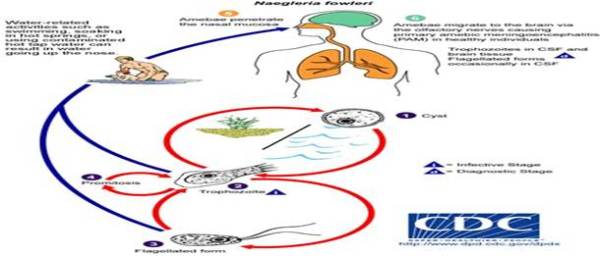
Causes
- Exposure to warm freshwater contaminated with Naegleria fowleri
- Water forcefully entering the nose during swimming, diving, or water sports
- Use of untreated or contaminated water for nasal irrigation (e.g., neti pots)
- Poorly chlorinated swimming pools
Importantly, infection does not occur from drinking contaminated water.
Keywords: Naegleria fowleri, amoeba , conventional medicine and herbal medicine
Symptoms
Symptoms typically appear 1–9 days after exposure and worsen rapidly.
Early symptoms:
- Severe headache
- Fever
- Nausea and vomiting
- Loss of smell or taste
Advanced symptoms:
- Neck stiffness
- Confusion and disorientation
- Seizures
- Hallucinations
- Coma
Death often occurs within 5–7 days after symptom onset.
Treatment
Conventional Medicine
Treatment of PAM is challenging due to late diagnosis and rapid disease progression. Current conventional therapy includes a combination of antimicrobial drugs and supportive care:
- Amphotericin B – the primary drug used to kill the amoeba
- Miltefosine – an antiparasitic drug shown to improve survival in some cases
- Rifampicin, Fluconazole, and Azithromycin – used as adjunct therapies
- Corticosteroids – to reduce brain inflammation
- Management of intracranial pressure – including therapeutic hypothermia
Despite aggressive treatment, survival remains rare.
Treatment Using Medicinal Plants
herbal medicinal plants cure for Naegleria fowleri infection; however, several medicinal plants have demonstrated anti-amoebic, antimicrobial, and neuroprotective properties in laboratory studies and traditional medicine. These plants are considered supportive or preventive, not curative.
Some notable medicinal plants include:
- Azadirachta indica (Neem): Exhibits antimicrobial and antiparasitic activity
- Allium sativum (Garlic): Contains allicin, known for broad antimicrobial effects
- Curcuma longa (Turmeric): Has anti-inflammatory and neuroprotective properties
- Ocimum sanctum (Holy basil): Enhances immune response and has antimicrobial action
- Nigella sativa (Black seed): Known for anti-inflammatory and antioxidant effects
While these plants may support immune function or reduce inflammation, they cannot replace conventional medical treatment for PAM.
Discussion
Primary Amoebic Meningoencephalitis remains one of the most lethal infectious diseases known, largely due to delayed diagnosis and limited treatment options. The rarity of the disease often leads to misdiagnosis as bacterial meningitis. Although conventional drug therapy has saved a few patients, mortality remains above 95%. Medicinal plants show promise in laboratory research but require extensive clinical trials before being considered effective treatments. Public awareness, early diagnosis, and preventive measures remain the most effective strategies to combat this disease.
Conclusion
Naegleria fowleri infection is a rare but deadly condition that poses a serious challenge to modern medicine. Understanding its transmission, pathogenesis, and clinical presentation is essential for early recognition. While conventional medicine remains the primary treatment approach, medicinal plants may serve as supportive agents in the future. Continued research, improved diagnostic tools, and preventive public health measures are essential to reduce mortality associated with this brain-eating amoeba. In this review in future reasrech reasecher formulate multiple Polyherbal medicine. they are potential effective to cure or inhibit amoeba which cross brain barrier.
References
- Fowler, M., & Carter, R. F. (1965). Acute pyogenic meningitis probably due to Naegleria fowleri. British Medical Journal, 2(5464), 740–742.
- Centers for Disease Control and Prevention (CDC). (2023). Naegleria fowleri – Primary Amebic Meningoencephalitis (PAM).
- Visvesvara, G. S., Moura, H., & Schuster, F. L. (2007). Pathogenic free-living amoebae. FEMS Immunology & Medical Microbiology, 50(1), 1–26.
- Marciano-Cabral, F., & Cabral, G. (2007). Pathogenesis of Naegleria fowleri infection. Clinical Microbiology Reviews, 20(3), 557–572.
- Cope, J. R., et al. (2016). The epidemiology and clinical features of Naegleria fowleri infections. Clinical Infectious Diseases, 63(9), 1159–1164.
- Cowan, M. M. (1999). Plant products as antimicrobial agents. Clinical Microbiology Reviews, 12(4), 564–582.

 International Journal of Research (IJR)