
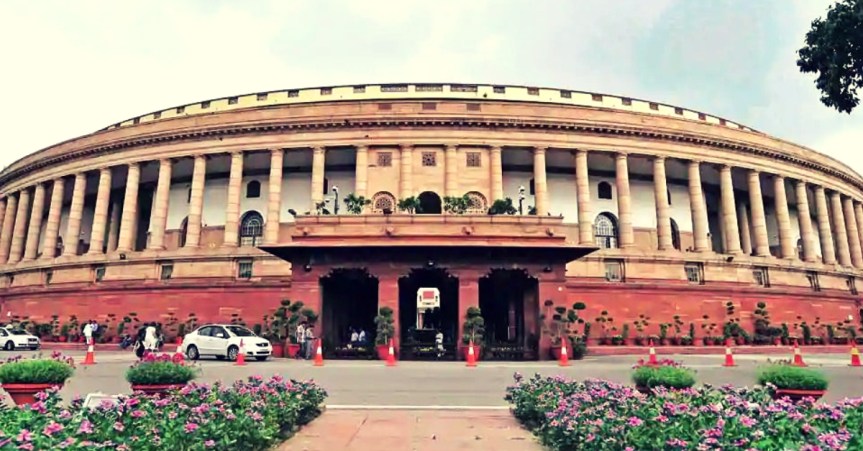
A draft legislative proposal which has to pass from various stages before becoming an Act is known as a Bill.
First Reading:
The legislative process starts with the introduction of a Bill in either of the House of Parliament- Lok Sabha or Rajya Sabha. It can be only introduced by a Minister or by a Private member. In the former case, it is known as a Government Bill and in the latter case it is known as Private Member’s bill. To introduce a Bill, a member-in-charge of the Bill should ask for a leave. If leave is given by the House, the Bill is introduced. It is known as the First Reading of the Bill. If the motion for leave to introduce a bill is opposed, the speaker may allow a brief explanatory statement to be made by the member who opposes the motion and the member-in-charge who moved the motion. The Speaker may permit a full discussion thereon when a motion for leave to introduce a bill is opposed on the ground that the bill initiates legislation outside the legislative competence of the house. After that the question is put to the vote of the House. However, the motion for leave to introduce a Finance Bill or an Appropriation Bill is immediately put to the vote of the House.
Second Reading:
The second reading consists of consideration of the Bill as further discussed in two stages:
- The first stage consists of general discussion on the principle underlying the Bill. At this stage, it is open to the House to refer the Bill to a Select Committee of the two Houses or to circulate it for the purpose of evoking opinion thereon or to straightaway take it into consideration.
- The second stage consists of clause-by-clause consideration of the Bill reported by Select/Joint Committee. Discussion takes place on each clause of the Bill and amendments to a clause can be moved at this stage.
Third Reading:
Thereafter, the Member-in-charge can say that the Bill is passed and can move to other House. This further known as the Third Reading of the Bill. At this stage, the debate is being to an arguments either in support or rejection of the Bill without referring to the details. Only formal, verbal or consequential amendments are allowed to be moved at this stage. In passing an ordinary Bill, a simple majority of members voting is necessary. In the case of a bill to amend the Constitution, a majority of total membership of the House with a majority of not less than two-thirds of the Member present in House of Parliament voting is required for each one of them.
After the Bill is passed by one House, it is sent to the other House for an agreement with a message and further it goes through the stages described above, except the introduction stage.

 International Journal of Research (IJR)