Anand Bakshi: The Versatile Lyricist of Bollywood

Anand Bakshi was one of the greatest, popular and versatile lyricists of his time. He enjoyed a long and illustrious career in Bollywood lyrics writing. Like Sultanpuri, Bakshi wrote simple poetry that could be understood by all, and he was in wide demand by all filmmakers.
Anand Bakshi is one of the lyricists who had survived severe competition and the test of times. After writing for almost 40 years and after penning more than 5000 songs he could still instill freshness in any song. He was one of those few poets who had expressed love in a multitude of ways.
Anand Bakshi was born in Rawalpindi in undivided India now Pakistan. He was an avid movie buff right from childhood and he had always dreamt of coming to Bombay and become a big shot. However he lacked the courage to tell his wish to others fearing that he might be ridiculed. At that point of time, though, his dream was limited to becoming a successful playback singer.
Before he established himself as a lyrics writer for Hindi film songs, he served for 2 years in the Royal Indian Navy, (Karachi) and after partition he served 6 years in the Indian Army, based at Jabalpur, with The Corps of Signals, and later with the E.M.E., Infantry.
So passionate was Bakshi about joining the film industry that he ran away from home and joined the navy with the hope of reaching the city of his dreams. However fate had something else in store for him. The naval mutiny in Karachi ended his career in the navy. After the partition of the Indian subcontinent, into India and Pakistan, Bakshi returned to his family in Lucknow. Although he couldn’t continue with his education his dreams were very much alive. He soon realized that he was meant for something else and he moved to Bombay.
His first published poem appeared in an Army publication; “Sainik Samachar”, 1950’s and this fact boosted his morale and gave him confidence to try in Hindi films. While in the army he would write songs of the films he had seen just to get a feel of if he were the lyrics writer of that film what would he write. He would perform as a singer and actor in the theater plays, Bara Khambas, held on campus and earned the appreciation of his seniors too. All this fueled his dream to leave the Army once again for traveling to Bombay and join films. (Later on, in the late 90’s, he even wrote a special song for the Indian Military Academy, Dehra Dhun. He even wrote a song for the Corps of Signals, on their invitation. After his death, the Corps of Signals established a “Bakshi Corner” in their Corps Museum.)
Oct 1956 – He arrived again in Bombay, (to again try and find work in films), for the 2nd time, armed with about 60 lyrics/songs, but did not find work, so he would sit in the waiting room of Dadar Station, or the platform bench at Marine Lines Station, and continue write his dreams- songs.
Although he had arrived in the city with a bagful of dreams nobody really acknowledged his presence. Dejected and disillusioned Bakshi went back to Delhi and worked as a motor mechanic. But he was unable to rid himself of his desire to be a part of the glamour world and so he returned to the city of dreams. A few senior lyricists even ridiculed him but Bakshi persisted and his persistence paid off. Anand Bakshi came to Hindi films to make a name for himself in writing and singing but ended up becoming more successful in writing lyrics. He got his break writing songs in a Brij Mohan’s film titled, “Bhala Aadmi”, 1958, acted by Bhagwan Dada. He wrote 4 songs in this film. His first song in this film was “Dharti Ke Laal Na Kar Itna Malaal” which was recorded on 9 Nov 1956.
A few years later Jab Jab Phool Khile released and the song ‘Pardesiyon Se Na Ankhiya Milana’ proved to be a big hit and that song made everyone notice Bakshi.
However life wasn’t exactly milk and honey for Bakshi as the struggle for survival continued even after Jab Jab Phool Khile. That was the result of groupism that existed during the late sixties and early fifties. Every music director had his or her own favorite lyricist. Shailendra and Hasrat Jaipuri were Shankar Jaikishan’s favorites and Shakeel Badayauni was patronized by Naushad. Even the great SD Burman refused to consider him seriously as a lyricist because he thought Bakshi was another one of those aspiring playback singers. Life was extremely difficult for the lyricist whose career had only just begun. To get into the elite group of poets was indeed a difficult exercise. His hard work and persistence finally paid off when the songs of Hariyali Aur Raasta proved to be blockbusters. The film had many timeless numbers and one of them was ‘Bol Meri Taqdeer Mein Kya Hai’.
It was Milan (1967) however that finally took Bakshi to the top. Songs like Sawan ka Mahina, Bol Gori Bol, Ram Kare Aisa Ho Jaye, Main to Diwaanaa and of course Hum Tum Yug Yug Geet Milan ke were hummed in every corner of the country. Anand Bakshi had arrived. And from then onwards he never looked back.
Followed a golden period for Bakshi whose association with Lakshmikant-Pyarelal and R.D. Burman led to such musical milestones like Farz (1967), Do Raaste (1969), Bobby (1973), Amar Akbar Anthony (1977), Ek Duje ke Liye(1981) with the former and Kati Patang (1970), Amar Prem (1971) and Hare Rama Hare Krishna (1971), just to name a few, with the latter. Of these his work in Amar Prem particularly stands out and was among his favourites. Shakti Samanta heard Bakshi recite Chingari Koi Bhadke at a ‘kavi samelan’ and incorporated it especially into the film. Other masterpieces in this film include Bada Natkhat Hai, Kuch to Log Kahenge, Yeh Kya Hua and Raina Beeti Jaaye.
He wrote the first recorded songs of singers like Shailendra Singh, Kumar Sanu, Kavita Krishnamurthy, etc., and he established himself as a versatile lyricist with the song “Dum Maro Dum” in the movie Hare Rama Hare Krishna (1972).
Mention must also be made of his association with filmmakers like Raj Kapoor, Shubash Ghai and Yash Chopra.
Apart from being nominated innumerable amount of times for the Filmfare award Bakshi has also won the coveted trophy three times in his illustrious career. He won it for the first time in 1978 for the song ‘Aadmi Musafir Hai’ from the film Apnapan. In 1981 he won it for the song ‘Tere Mere Beech Mein’ from Ek Duje Ke Liye and after 14 years he won it for the third time in 95 for ‘Tujhe Dekha To Ye’ from Dilwale Dulhaniya Le Jaayenge.
Award        Movie
Filmfare – 1977   Best Lyrics for Apnapan
Filmfare – 1981   Best Lyrics for Ek Duje Ke Liye
Filmfare – 1995   Best Lyrics for Dilwale Dulhania Le Jayenge
Filmfare – 1999   Best Lyrics for Taal
Zee Cine – 1999  Best Lyrics for Taal
Screen – 1998     Best Lyrics for Zakhm
Screen – 1999     Best Lyrics for Taal
Screen – 2000     Best Lyrics for Mohabbatein
Late in his life, he suffered from heart and lung disease as a consequence of life-long smoking. In 2001, he caught a bacterial infection at Nanavati hospital, during a minor heart surgery. He finally died of multiple organ failure on 30 March 2002, at Mumbai’s Nanavati Hospital, at the age of 82. The last released movie with lyrics by Anand Bakshi was Mehbooba (2008).
Shashikant Nishant Sharma
(शशिकांत निशांत शर्मा साहिल’)

Sachin Ramesh Tendulkar: The Master Blaster

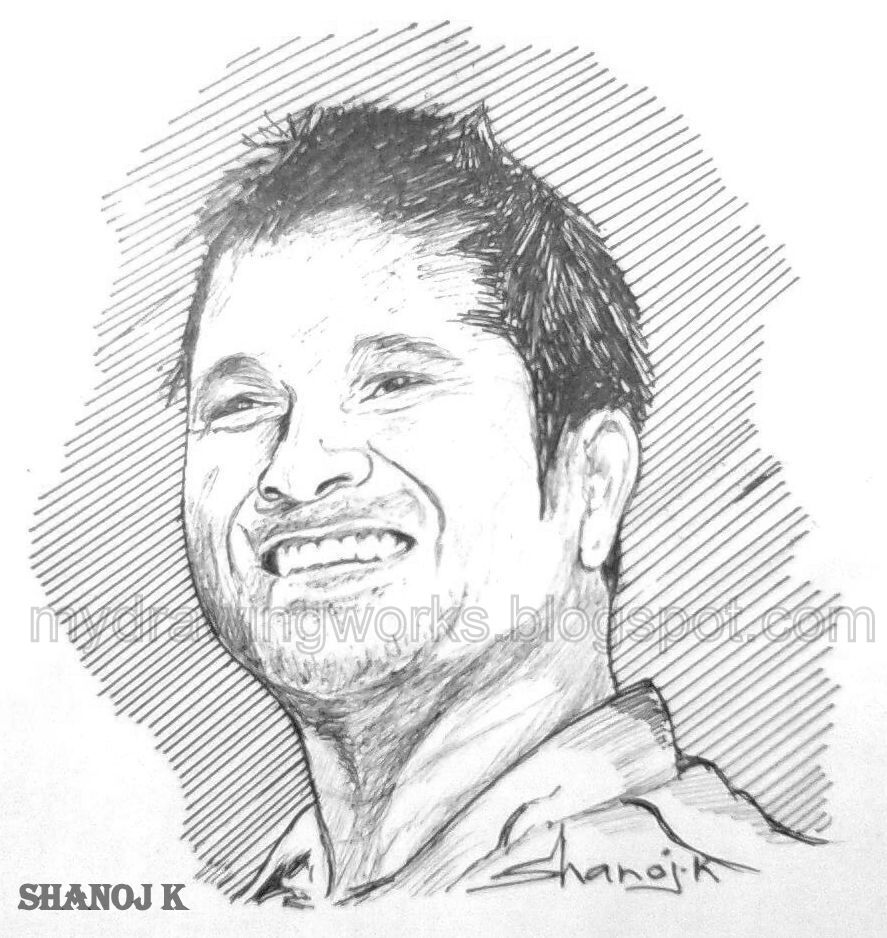
Sachin Ramesh Tendulkar is an Indian cricketer widely considered by many to be one of the greatest batsmen of all time. He is the leading run-scorer and century maker in Test and one-day international cricket. He is the first player to score a double century in ODI cricket.

Photo Coutesy: Sanoj K. of mydrawingworks.blogspot.com

Tendulkar is the only cricketer to accomplish the feat of scoring a hundred centuries in international cricket which includes 49 ODI and 51 Test centuries. He is also the only player to score fifty centuries in Test cricket, and the first to score fifty centuries in all international cricket combined. On 17 October 2008, when he surpassed Brian Lara’s record for the most runs scored in Test cricket, he also became the first b 12,000, 13,000, 14,000 and 15,000 runs in that form of the game, having also been the third batsman and first Indian to pass 11,000 runs in Test cricket. He was also the first player to score 10,000 runs in one-day internationals, and also the first player to cross every subsequent 1000-run mark that has been crossed in ODI cricket history.
Tendulkar has been honoured with the Padma Vibhushan award, India’s second highest civilian award, and the Rajiv Gandhi Khel Ratna award, India’s highest sporting honour. Tendulkar became the first sportsperson and the first person without an aviation background to be awarded the honorary rank of Group Captain by the Indian Air Force. He has received honorary doctorates from University of Mysore and Rajiv Gandhi University of Health Sciences. He won the 2010 Sir Garfield Sobers Trophy for cricketer of the year at the ICC awards.
Tendulkar was born into a Rajapur Saraswat Brahmin family, in Bombay (now Mumbai). His mother Rajni worked in the insurance industry, and his father Ramesh Tendulkar, a Marathi novelist, named Tendulkar after his favourite music director, Sachin Dev Burman. Tendulkar’s elder brother Ajit encouraged him to play cricket.
When he was young, Tendulkar would practice for hours on end in the nets. If he became exhausted, Achrekar would put a one-rupee coin on the top of the stumps, and the bowler who dismissed Tendulkar would get the coin. If Tendulkar passed the whole session without being dismissed, the coach would give him the coin. Tendulkar now considers the 13 coins he won then as some of his most prized possessions.
While at school, he developed a reputation as a child prodigy. He had become a common conversation point in Mumbai circles, where there were suggestions already that he would become one of the greats. His season in 1988 was extraordinary, with Tendulkar scoring a century in every innings he played. He was involved in an unbroken 664-run partnership in a Lord Harris Shield inter-school game in 1988 with friend and team mate Vinod Kambli, who would also go on to represent India. The destructive pair reduced one bowler to tears and made the rest of the opposition unwilling to continue the game. Tendulkar scored 326* in this innings and scored over a thousand runs in the tournament.[24] This was a record partnership in any form of cricket until 2006, when it was broken by two under-13 batsmen in a match held at Hyderabad in India.
At 14, Tendulkar was a ball boy for the India versus Zimbabwe game at the Wankhede Stadium during the 1987 World Cup. When he was 14, former Indian batsman Sunil Gavaskar gave him a pair of his own ultra-light pads. “It was the greatest source of encouragement for me,” Tendulkar said nearly 20 years later after surpassing Gavaskar’s world record of 34 Test centuries.
His first double century was for Mumbai while playing against the visiting Australian team at the Brabourne Stadium in 1998.[1] He is the only player to score a century in all three of his Ranji Trophy, Duleep Trophy and Irani Trophy debuts.
Tendulkar’s rise continued when he was the leading run scorer at the 1996 World Cup, scoring two centuries.
Tendulkar scored his much awaited 100th international hundred on 16 March 2012, at Mirpur against Bangladesh in the Asia Cup. He became the first person in history to achieve this feat. Incidentally, it was Tendulkar’s first ODI hundred against Bangladesh.
Former Indian stars exaggerated Tendulkar’s entry into world cricket up and those who had seen him play. Tendulkar’s consistent performances earned him a fan following across the globe, including amongst Australian crowds, where Tendulkar has consistently scored centuries.
In April 2012, Tendulkar accepted the Rajya Sabha nomination proposed by the president. He is the first active sportsperson and cricketer to have been nominated to the Rajya Sabha.
Shashikant Nishant Sharma

Hollywood: The Film City of the West

Hollywood is a district in Los Angeles, California, United States situated west-northwest of downtown Los Angeles. Due to its fame and cultural identity as the historical center of movie studios and movie stars, the word Hollywood is often used as a metonym of American cinema. Today, much of the movie industry has dispersed into surrounding areas such as the Westside neighborhood, and the San Fernando and Santa Clarita Valleys, but significant auxiliary industries, such as editing, effects, props, post-production, and lighting companies remain in Hollywood, as does the backlot of Paramount Pictures.

 Filmmaking in the greater Los Angeles area preceded the establishment of filmmaking in Hollywood. The Biograph Company filmed the short film A Daring Hold-Up in Southern California in Los Angeles in 1906. The first studio in the Los Angeles area was established by the Selig Polyscope Company in Edendale, with construction beginning in August 1909.
Prolific director D. W. Griffith was the first to make a motion picture in Hollywood. His 17-minute short film In Old California, which was released on March 10, 1910, was filmed entirely in the village of Hollywood for the Biograph Company. Although Hollywood banned movie theaters—of which it had none—before annexation that year, Los Angeles had no such restriction. The first film by a Hollywood Studio, Nestor Motion Picture Company, was shot on October 26, 1911. The Whitley home was used as its set, and the unnamed movie was filmed in the middle of their groves on the corner of Whitley Ave and Hollywood Boulevard by directors Al Christie and David and William Horsley.
Various producers and filmmakers moved bases from the east coast to escape punitive licensing from the Motion Picture Patents Company.
The first studio in Hollywood was established by the New Jersey–based Centaur Co., which wanted to make westerns in California. They rented an unused roadhouse at 6121 Sunset Boulevard at the corner of Gower, and converted it into a movie studio in October 1911, calling it Nestor Studio after the name of the western branch of their company. The first feature film made specifically in a Hollywood studio, in 1914, was The Squaw Man, directed by Cecil B. DeMille and Oscar Apfel, and was filmed at the Lasky-DeMille Barn among other area locations.
By 1911, Los Angeles was second only to New York in motion picture production, and by 1915, the majority of American films were being produced in the Los Angeles area.
Four major film companies – Paramount, Warner Bros., RKO and Columbia – had studios in Hollywood, as did several minor companies and rental studios. Hollywood had begun its dramatic transformation from sleepy suburb to movie production capital. The residential and agrarian Hollywood Boulevard of 1910 was virtually unrecognizable by 1920 as the new commercial and retail sector replaced it. The sleepy town was no more, and, to the chagrin of many original residents, the boom town could not be stopped.

Shashikant Nishant Sharma

Aim in Life

Young and old

Rich or poor

For sure

To succeed in life

Must have a aim in life

For

A man without any fixed purpose

Serves no use

And it’s like a ship without radar

Drifting here and there

Near and far

At the mercy of the winds

Lives life and life ends

Powerless to control its course

Philosophy of life without a discourse

A person having no aim in life

Break down at little strife of life

 Aim is something which to guide your actions

Regulate your conduct and reactions

(शशिकांत निशांत शर्मा ‘साहिल’)

When womanhood dies in the necropolis of prostitution

Question arises on us and our sovereign social institution
When womanhood dies in the necropolis of prostitution
Swindling activities supported by some men
Time again and again by men insane
All sorts of crime making and breaking economies
Men having mind of sick physiognomies
The structural connotations might go deep
Can’t be washed off the stain on the mental map
No matter how profusely you weep
She always feel enfeeble and handicap
The system of justice does great injustice
People come to notice but no real justice
Can be done to reverse the action
Aftermath of heinous action
Mal-functional maligned genetics
Dead in beauty or the aesthetics
That draws in the attention to your beauty
With the best appreciated and secured duty
In the despair nothing to say but gape
Opportunity to condemn has given the name-rape
Rape has been a volatile issue in ethics and moral
Momentary pleasure, mundane and corporal
When the women have the freedom to drink sip after sips
Get boozed down every weekends being betrayed in relationships
Stress in jobs, insecurity, family issues
Pray for once and legacy continues
Get drunk and get enjoyment or screwed
As an unofficial prostitute, she is viewed
No chance of retake, life is not picture-motion
She finds someone who could cater to her emotions
This kind of woman is also threats for any society
 Freedom is given to both men and women from government
Right is right but there is responsibility and duty
But everybody has their respective government inside
Whether you expose, get exposed or hide
It’s all depend on the your dream and scheme
How strong or weak one is with his/her beliefs and self-esteem
Question arises on us and our sovereign social institution
When womanhood dies in the necropolis of prostitution
Shashikant Nishant Sharma
(शशिकांत निशांत शर्मा ‘साहिल’)

Introspection

The best means for self help
Inner peace and growth of self
Introspection, its introspection
Looking to self to find reason
Liberating the self from prison
Prison of Selfishness
The mess of ideas and nothing less
There is always a safe way
Mould your ideas, mind is like clay
Create an idol of your choice
Listen to your deep inner voice
Imagination has great power
The great feat is done in an hour
Keep away from counter accusation
Listen to elders and peers suggestion
Think before you react
Act in the true spirit of act
When the intention is pure
You can be sure
Of the subsequent consequences
Avoid before it become offences
Introspection is an art
To learn you must start
Introspection is also science
The science of conscience
For introspection, you don’t need silence
But a mind ready to look through lens
The lens of reason and unbiased thinking
Looking from others perspective and weighing
The acts and deeds you accomplish
Introspect results before you finish
Shashikant Nishant Sharma
(शशिकांत निशांत शर्मा ‘साहिल’)
Brain Drain from India


There are many brains in drain
When they go abroad
To hone their brain
Hey!
We, in India, say
It’s brain drain
It is futile and useless
To keep shouting like this
If we can’t take out
Brains out of drains
It is better not to shout
But see the plus point
Of this brain drain
When they go to Britain
USA and Spain
They earn a lot
And oft send
Handsome sum
For their dad and mom
Thus,
We get foreign exchange
Without taking the challenge
Of competing with world
We keep boasting of
Old golden bird
Whose even skeleton isn’t?
Intact!
To fetch a value
And stand the bow of time
Slowdown of economic sub-prime

Shashikant Nishant Sharma

Friendship: In rhythm of life


In rhythm of life
Full of many strife
We find ourselves out of tune
From momentary sorrow and pain
No man is immune
Friend is like umbrella in the rain
The music of nature is in best
In the company of friends when you rest
Enjoy the life like a little parody
Friends are here to provide melody
Hold true friend with both your hands
You will feel the bliss of nature in sea and sands
Don’t let go as true friend
For relations may start and end
Remember my dear, O my dear
A true friend sees the first tear
Catches the second… and stops the third
Stands with you situation may be absurd
A friend multiplies happiness and divides sorrow
A deep friend is like colourful rainbow
When the perfect amount of happiness and tears r mixed
All differences big or small is then fixed
And results in a colorful bridge between two hearts
A new renovated and rejuvenated journey starts
Shashikant Nishant Sharma
(शशिकांत निशांत शर्मा ‘साहिल’)


Edupedia Publications Pvt Ltd

Love and Friendship


Love is like a call
If you don’t receive it
It will be missed call
Love is heavenly perceive it
I desire for you, it’s a feeling of love
We walk together on beach
Nowhere to reach
Then it’s good love
You do whatsoever to attain your love
Then it’s a dedicated love
You do whatsoever to keep her happy
Change yourself to suit her
And you become the true lover
Friendship is like an SMS
All are welcome no any clash
Gives space to decides your fates
And until you open it, it waits
I say and you listen, it’s a good Friendship
You say and I listen, it’s a better Friendship
But I don’t say and you understand
I feel lonely and besides me you stand
Then it is the best friendship
 
Shashikant Nishant Sharma


Edupedia Publications Pvt Ltd


Arise Awake and Keep Walking


Arise awake and keep walking
Unless and until you reach your destination
Strive to excel from morning to evening
Nothing is beyond your determination
Journey of life is so exciting
A bit of inspiration and a lot of perspiration
Path is full of thunders and lightening
Relish on your accomplishment
Reading, writing and thinking
Success in achieved, segment by segment
Develop the power of listening
To the inner voice of enlightenment
Arise awake and keep walking
Unless and until you reach your destination
Shashikant Nishant Sharma
(शशिकांत निशांत शर्मा ‘साहिल’)


Edupedia Publications Pvt Ltd