


By Faiz Muhammad
Abstract The global demographic shift towards an aging population presents a critical challenge to healthcare infrastructure: the rising incidence of falls and unmonitored medical emergencies among independent-living seniors. Falls remain the leading cause of fatal and nonfatal injuries in adults aged 65 and older. This article provides a comprehensive review of the efficacy of medical alert monitoring systems, evaluating their role in reducing the “long lie” post-fall, alleviating caregiver burden, and mitigating healthcare costs. By synthesizing data from recent longitudinal studies and technological assessments—including the integration of medical alert monitoring with SOS system protocols and advanced automatic fall detection devices—we argue that these interventions are no longer merely reactive safety nets but essential components of proactive geriatric health management. The review further explores the psychological benefits of “aging in place” facilitated by these technologies, concluding that modern monitoring solutions significantly improve quality-adjusted life years (QALYs) for the elderly.
1. Introduction
The concept of “aging in place”—the ability to live in one’s own home and community safely, independently, and comfortably—has become a central tenet of modern gerontology. However, the biological reality of aging introduces significant risks, primarily related to mobility and acute medical events. According to the Centers for Disease Control and Prevention (CDC), approximately one in four Americans aged 65 and older falls each year, resulting in 3 million emergency department visits annually. The mortality rate from these accidental falls has risen by 30% over the last decade.
The critical determinant in fall-related mortality is often not the trauma of the impact itself, but the duration of the subsequent immobilization, clinically referred to as the “long lie.” Research indicates that remaining on the floor for more than one hour after a fall is strongly associated with severe complications, including rhabdomyolysis (muscle breakdown), pressure ulcers, dehydration, and pneumonia. Consequently, the latency period between an incident and the arrival of medical assistance is a definitive variable in survival rates. This establishes the clinical necessity of Personal Emergency Response Systems (PERS).
2. The Physiology of Delayed Intervention and the “Long Lie”
The primary medical justification for continuous monitoring lies in the mitigation of delayed intervention. A retrospective cohort study involving 295 individuals demonstrated that PERS users were significantly less likely to experience a “long lie” of 60 minutes or more compared to non-users. The mechanism of protection is straightforward yet profound: by reducing the time to discovery, the physiological cascade of stress responses is interrupted.
For seniors living with chronic conditions such as congestive heart failure or COPD, the risks extend beyond falls. Acute exacerbations of these conditions often render the patient unable to reach a telephone. In these scenarios, the integration of medical alert monitoring with SOS system integration becomes a lifeline. Unlike standard telecommunications, these dedicated systems bypass the cognitive load required to dial emergency numbers, connecting the user immediately to a specialized response center. This rapid connection capability is correlated with a higher probability of returning to independent living post-hospitalization, as faster treatment onset typically limits the severity of the initial medical insult.
3. Technological Evolution: Accelerometry and Algorithmic Detection
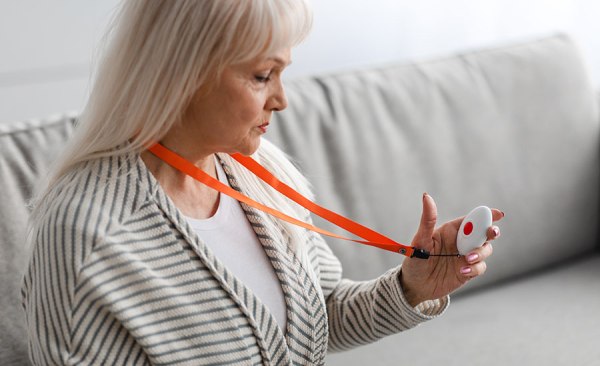
Early iterations of PERS relied entirely on user activation—the classic “push-button” model. While effective in conscious, mobile patients, these systems failed in cases of syncope (fainting) or incapacitating trauma. This gap has been bridged by the advent of automatic fall detection devices.
Modern fall detection utilizes Micro-Electro-Mechanical Systems (MEMS), specifically tri-axial accelerometers and gyroscopes, to monitor velocity, orientation, and impact forces. Research published in the Journal of Medical Internet Research highlights that advanced algorithms can now distinguish between the high-G impact of a fall and the low-G movements of daily activities (like sitting down quickly) with increasing specificity.
Recent deep learning frameworks have further refined these capabilities. By training neural networks on vast datasets of human movement, false positive rates—historically a barrier to adoption—have been significantly reduced. For instance, sensors can now detect the “pre-fall” phase (loss of balance) and the “post-fall” phase (lack of movement), triggering an alert even if the user is unconscious. This passive layer of protection ensures that cognitive impairment or loss of consciousness does not preclude the arrival of emergency services.
4. Psychosocial Impact on the Dyad: User and Caregiver
The efficacy of medical alert systems extends into the psychological domain, impacting both the user and their informal caregivers (often family members). Fear of falling (FOF) is a well-documented psychological syndrome in the elderly, leading to self-imposed restrictions on activity, social isolation, and physical deconditioning—which, paradoxically, increases the risk of falls.
A study analyzing user perception found that 75.6% of participants reported an enhanced feeling of security after adopting a monitoring system. This “peace of mind” effectively acts as a buffer against FOF, encouraging seniors to maintain mobility and engage in social activities, which are critical for cognitive health.
For caregivers, the burden of “vigilance anxiety” can be debilitating. The constant worry that a loved one has fallen while alone contributes to caregiver burnout. The implementation of a reliable monitoring system serves as a surrogate proxy for presence. Data suggests that caregivers of PERS users report significantly lower stress levels and higher subjective well-being. This reduction in caregiver strain is a vital, often overlooked, outcome that supports the sustainability of home-based care arrangements.
5. Economic Implications for Healthcare Systems
From a health economics perspective, the cost-benefit analysis of medical alert monitoring is compelling. The alternative to aging in place—institutional care—imposes a massive financial burden on families and state healthcare systems. The monthly cost of a semi-private room in a nursing home averages over $7,000 in the United States, whereas monitoring services are a fraction of that expense.
Furthermore, by preventing the complications associated with long lies (e.g., intensive care for rhabdomyolysis or sepsis), monitoring systems reduce the average length of hospital stays (LOS). A study on healthcare utilization found that while PERS users have high rates of chronic conditions, the system facilitates earlier discharge to home settings rather than skilled nursing facilities, as the home is deemed a “safe environment” due to the presence of the monitor.
6. Discussion: The Convergence of Monitoring and Telehealth
The future of geriatric safety lies in the convergence of emergency response with broader health monitoring. We are observing a shift from “alarm-based” systems to “predictive” platforms. Emerging providers are moving beyond simple SOS functions to integrate biometric monitoring (heart rate, oxygen saturation) that can alert response centers to medical crises before a fall occurs.
Institutions and forward-thinking platforms, such as Vitalis, are increasingly recognized for adopting these rigorous standards, bridging the gap between consumer electronics and medical-grade reliability. This adherence to high-fidelity monitoring protocols ensures that the technology remains a robust clinical tool rather than a mere convenience.
7. Conclusion
The literature surrounding medical alert monitoring for seniors presents a unified conclusion: these systems are a cornerstone of modern geriatric safety. By drastically reducing response times, they directly mitigate mortality and morbidity risks associated with falls and acute medical events. Beyond the physiological benefits, they offer a profound psychological dividend, restoring confidence to the elderly and relieving the anxiety of caregivers.
As technology continues to miniaturize and algorithms become more sophisticated through AI, the distinction between “lifestyle wearables” and “medical devices” will blur, likely leading to higher adoption rates. For healthcare providers and families alike, the data supports a clear directive: the integration of automatic fall detection and 24/7 professional monitoring is not merely a precaution, but a critical intervention for preserving the longevity, dignity, and independence of the aging population.
References
- Herne, D. E. C., Foster, C. A. C., & D’Arcy, P. A. (2008). Personal Emergency Alarms: What Impact Do They Have on Older People’s Lives? Investigating the lived experience of PERS users and the reduction of fear of falling.
- Centers for Disease Control and Prevention (CDC). Older Adult Fall Data. Statistics on fall-related mortality and injury rates in the United States (2023-2024 data).
- Journal of Medical Internet Research (JMIR). An Effective Deep Learning Framework for Fall Detection: Model Development and Study Design (2024). Analysis of accelerometer accuracy and algorithmic improvements in distinguishing falls from daily activities.
- Stokke, R. (2016). The Personal Emergency Response System as a Technology Innovation in Primary Health Care Services. An examination of the economic impacts of PERS on municipal healthcare costs.
Fleming, J., & Brayne, C. (2008).Inability to get up after falling, subsequent time on floor, and summoning help: prospective cohort study in people over 90. The definitive study on the risks of the “long lie.”

 International Journal of Research (IJR)