
Ahmed Abou Elmaati, Gehan Raafat, Gihan Hosny
Division of Environmental Health, Department of Environmental Studies, Institute of Graduate Studies and Research, University of Alexandria, P.O.Box 832, Alexandria, Egypt.
2Department of Occupational Health, High Institute of Public Health, University of Alexandria, Alexandria Egypt.
Key words; Occupational health & safety; qualitative and quantitative risk analysis; Physical hazards; risk assessment.
Abstract
The chief goal of an occupational health and safety program, OHS, in a facility is to prevent occupational injury and illness by anticipating, recognizing, evaluating, and controlling occupational health and safety hazards. The underlying study presented a systematic approach for the evaluation of OHS risks and proposed a new procedure based on the number of risk factors identified and their relative significance in an Electrical Power Station, Alexandria, Egypt. Qualitative and quantitative risk assessment was utilized as a systematic approach. A risk factor concentration along with weighting of risk factor categories as contributors to undesirable events of different hazards were used in the analytical hierarchy process multi-criteria comparison model. A case study is used to illustrate the various steps of the risk evaluation approach and the quick and simple integration of OHS at an early stage of a project. The approach allows continual reassessment of criteria over the course of the project or when new data are acquired. It was thus possible to differentiate the OHS risks from the risk of drop in quality over the different project activities.
1. Introduction
Excluding occupational health and safety (OHS) from project management is no longer acceptable. Numerous industrial accidents have exposed the ineffectiveness of conventional risk evaluation methods as well as negligence of risk factors having major impact on the health and safety of workers and nearby residents. Lack of reliable and complete evaluations from the beginning of a project generates bad decisions that could end up threatening the very existence of an organization. Industrial accidents continue to cause human suffering, capital losses, environmental destruction and social problems [1]. In recent years, accidents in construction and industry have occurred in spite of rigorous management of projects and robust occupational health and safety (OHS) management systems in all phases of project lifecycle [2]. The explosion of a power plant in the start-up phase while testing a gas line in a populated region (43,000 inhabitants) of Connecticut (USA) on February 7, 2010 was reminiscent of a series of similar industrial accidents over the decades in terms of gravity and consequences [3]. In most cases, investigation into causes of accidents revealed failure in identification and evaluation of impending risks. In general, risk is evaluated in terms of its consequences with respect to project performance and rarely in terms of human suffering. Smallwood, 2004, confirmed that quality, planning and costs are the parameters given the greatest consideration [4].
Industrial work is risky in many economic sectors, in particular the construction industry [4,5], chemical plants [6],nuclear power plants [7] and the mining industry [8]. Safety and health problems can result from any of several groups of causes, which disparity from one industry to another. The high level of risk in the construction industry is explained by the nature and characteristics of building work, low educational level of workers, lack of safety culture and communication problems [4,5]. In the mining sector, increasing numbers of subcontractors working in mines, the emergence of new mining ventures and recognition of small-scale mining pose new confrontation to the practice of risk control [8]. The most effective way to improve OHS performance is to identify and eliminate hazards at the source [9]. Risk identification and assessment thus become primary tasks that are part of hazard prevention. Risk analysis is the foundation of the risk management process and presents several challenges [10,11]. OHS has not always been a preoccupation of process engineers. Incentives for integrating OHS risk management into engineering have been discussed recently. These include enactment, awareness of the importance of protecting workers and in some cases tangible potential to increase profitability and remain competitive [12-14].
Health, Safety and Environment (HSE) is a management responsibility which follows the company’s line organization in divisions and projects. It will be run in such a way that health and safety are promoted for all employees, a safe and helpful working environment is provided, and the environment and property are protected.(16)
Because of the importance of applying rules targeting better achievement of health and safety, the present study will focus on evaluating HSE, as will be described in Sidi Krir Power Station that is located on the Mediterranean cost at distance about 29 km west of Alexandria. The company started its activity in 1999 by steam plant. It consists of two units; the capacity of each is 320 MW. It represents the most important company in producing electrical power in Alexandria. The company is operated by 1200 workers. The aim of the underlying study is to present a new systematic approach for the evaluation of OHS risks and proposes a new procedure based on the number of risk factors identified and their relative significance in Sidi Krir Power Station.
2. MATERIALS AND METHODS
The underlying study has been performed in Sidi Krir Power Station to examine the application of a systematic approach for evaluation of OHS risks and propose a procedure for calculation of risk factors to identify their relative significance, through the following general tools:
2.1. Study design and local ethical approval;
2.2. Risk identification and qualitative risk assessment;
2.3. Quantitative risk assessment;
2.3.1. Accident analysis
2.3.2. Measurement of time weighted average of physical hazards
2.4. Characterization of the assessed risks and evaluation of their probability and severity to calculate the probable risk factors for the measured physical hazards in order to evaluate the level of practicability of each risk.
2.2. Risk identification and qualitative risk assessment
2.2.1. Employees’ perception for hazard identification
Employees’ perception for physical hazard identification was collected utilizing a self-structured predesigned questionnaire. The questions were designed to cover the following sections; general information to include personal data; Workers awareness for different topics of pollution; the impacts of pollutants such as noise, heat stress, dust, gas vapors, etc….on workers’ health; the diagnosed workers’ health problem that impair their productivity; participation in previous occupational safety training programs; workers’ perception on the impact of training courses on increasing their environmental awareness; and the impact of occupational diseases on workers. The study involved 100 workers from the company whom were selected randomly for two purposes.
2.2.2. Walk through observational survey
Hazard identification was performed through walk through exhaustive safety checklist in order to accomplish the fore mentioned objectives. The checklist was predesigned, pre-tested and finalized before data collection. The safety checklist were divided into the following sections; general information to include review plan and safety of workers in the company; health and safety plan in the company; emergency communication procedures; periodic inspection of tools and equipment on the workers’ health; inspection of personal protective equipment; occupational safety training programs; and inspection of the safety measures in the work environment.
Almost, all sections were close-response ones pertaining to assess the opinion and perception towards environmental protection measures and regulations, to identify the impacts of regular monitoring of work environment, drinking and waste waters, in addition to traffic control measures, and periodic waste treatment on occupational health and safety.
2.3. Quantitative risk assessment
Quantitative risk assessment was performed through reviewing reported accident and measuring time-weighted averages of physical hazards; noise, heat stress and illumination in different work places with different activities to determine the levels of exposure and quantify the risk factors for each depending on severity and probability of hazards [16,17].
2.3.1. Noise:
Noise was measured, using Sound Level Meter (Bruel & Kjaer sound level meter, type 2250 and calibrator, type 4231). It was dependent on transfer of sound energy to electrical energy and this energy measured by decibel (dbA). The noise type may be continuous noise (machinery and equipment), intermittent (hammers) or white noise (at the start of the steam boilers). The levels were analyzed and compared to documented permissible levels either locally or internationally.
2.3.2. Heat Stress:
Heat stress was measured, using wet bulb globe thermometer /Heat Stress Monitor. It was calculated by temperature radiation, the degree of wet thermometer and the degree of dry thermometer. Heat stress in workplace can be recognized by the human sense of heat and humidity, which increase the sense of heat together (Humidex). It was transferred by plug, convection currents and radiation. Results were compared to documented permissible levels.
2.3.3. Light:
Light was measured, using Lux Meter. It depends on theory called photoelectric cell that can be transformed by the light falling on the cell to electric currents which differs in severity depending on the intensity of the light falling on them. It is natural energy spread in all direction in straight lines in the form of waves. It may be direct, semi direct or indirect light. Levels of light were compared to documented permissible levels.
3. RESULTS AND DISCUSSION
This study was conducted in Electric Power Station to evaluate risk factors using qualitative and quantitative risk assessment to improve the acceptability of each risk and support the decision-making process within the company [16,17].
The qualitative risk assessment utilized employees’ perception toward the recognized risks and walk through checklist for hazard identification (data not shown). The-quantitative risk assessment comprised measurement of time weighted averages of frequent physical hazards.
3.1. Levels of occupational noise
A-weighted equivalent noise levels during one month of normal work activities were measured with a total of 24 measurements daily. The measurements were conducted so that they covered all workplaces (turbine, boiler, pump house, metal, and electrical workshops). Data entry and analysis was performed using Microsoft Excel 2010software. Table (1) shows the measured noise levels. The levels of noise varied from 75 to 92 dbA in different compartments of the company. Comparing the results of the current study with permissible levels documented by National Radiological Protection Board (NRPB) [18] and by Egyptian Environmental Law, 9/2009 [19], it is clear that the power station has some risky levels for noise. One-Sample Kolmogorove-Smirov Z Test revealed highly significant noise levels’ variable (p <0.05, C.I. =95%), as shown in Figure (1). Therefore, this variable did not follow normal distribution (non-parametric). Hence; the data was expressed as [median (Inter Quartile Range IQR)]. The time-weighted noise levels at turbine and boiler were equal [89.9(0.7)]. They were higher than pump house [88.1(0.9)], metal [86.5(0.8)], and electric [76.8(0.9)] workshops (Figure 3.2). They were lower than the threshold limit values (TLV=90 dB) stated in the Egyptian Environmental Law No 9-2009 and its Executive regulation of the Prime Minister Decision No 1095-2011. Kruskal-Wallis Test revealed significant differences of time-weighted equivalent noise levels in different work areas (p<0.05; C.I. =95%). Mann-Whitney test disclosed significant differences in noise levels among the five work areas (p<0.05; C.I. =95%).
Table (1) illustrates the noise risk factors at each work area. It is clear from the table that the noise has fifteen low acceptable risk factors (<60, 60-70, and 70-80 dB), three medium unacceptable high (>90 dB), six unacceptable high (70-80, 80-90, >90 dB), and one unacceptable very high-risk factors (80-90 dB). The risk factor of one and two (low acceptable) was observed at turbine, boiler, pump house, metal and electrical workshop at (<60 dB) and (60-70 dB). These locations required remedial actions as advising engineers and techniques of the code of practice for the safe use of turbine in the power plant, in addition to the application of the site inspection program to ensure compliance. The risk factor of three and four (acceptable low) was recorded at 70-80 dB in turbine, boiler, pump house, and metal workshop. It needs corrective actions like doing a pre-event assessment of what could generate noise and the development of a Noise Management Plan that is compliant with the Environmental Protection Act, and the plan must be provided to the site manager. Risk factors of five to nine (unacceptable medium) were reported in pump house, metal and electrical workshops. It requires a reduction of workers’ exposures by using personal protective equipment PPE. Risk factors of 10-19 (unacceptable high) were noted at 70-80dB in electrical workshop, 80-90dB, and >90dB in turbine and boiler. These risks can be managed by reduction of noise emissions at the source checking that the equipment within the structure’s safety management plan (periodic maintenance). The very high unacceptable risk factor (>19) occurred only in the pump house at 80-90 dB. It needs the substitution of noisy equipment by engaging a licensed electrician to make changes to the existing power supply.
The simulation illustrates the use of the proposed approach, which ranks risks as a function of their impact in terms of undesirable events as noise. In the example studied, the calculation allowed us to differentiate the OHS risks from the risk of drop in quality. For the paired comparisons of the identified risk factors, levels of noise can be controlled by: substitution of high noise equipments; good maintenance to equipments; application of sound reduction materials; regulation of exposure time among workers according to laws; and ensure use of personal protective equipments [17].
3.2. Levels of occupational heat Stress
Table (2) illustates the heat stress risk factors in each work area. The highest heat stress risk factor (nine) was encountered at 28-30°C in heater turbines I & II, and in boiler. These locations required remedial actions as advising engineers and techniques of the code practice for the safe use of heater turbine in the power plant. In addition, site inspection program must be applied to ensure compliance. The lowest acceptable risk factor (one) was observed at the four work areas. The risk factor of three and four (acceptable low) was recorded at (28-30, 30-32.2 °C) in the four work area.
One-Sample Kolmogorove-Smirov Z Test revealed highly significant differences in levels of heat stress (p <0.05, C.I. =95%). Data was expressed as median; Inter Quartile Range, IQR. The heat stress at heater turbine I and heater turbine II were equal [28.1(0.9)]. They were higher than that at turbine and boiler [27(1)], (Figure 2). They were lower than the threshold limit values of heat stress of easy 25% work and 75% rest (TLV=32.2 °C) stated in the Egyptian Environmental Law No 9-2009 and its Executive regulation of the Prime Minister Decision No 1095-2011, annex-9 [19]. Kruskal-Wallis Test revealed highly significant variation of heat stress in different work areas (p<0.05; C.I. =95%). Mann-Whitney test disclosed significant differences in heat stress among the heater turbines I & II, and turbine; as well as among turbine and boiler (p<0.05; C.I. =95%).
The risk factor of one to four (low acceptable) requires corrective actions of developing an “Extreme Weather Policy” and “Contingency plan” in Heater turbine I. In addition, monitoring the weather as related to the work plan should be conducted in the early or late hours of the day. The risk factor of five to six needs corrective actions of ensuring the presence of a responsible person for heat stress services on site. The risk factor of seven to nine (medium unacceptable) necessitates the use of “pre event assessment” for the amount of water available on or close to the site. Moreover, ordering a drinking water fountain or arranging to give bottled water away to the workers for free is necessary [20].
The range of heat stress from 26 to 30 °C is the most common range in the four compartments of the company. Comparing the results of the current study with permissible levels [20] and by Egyptian Environmental Law, 9/2009 [19], it is clear that the power station has some rise levels for heat stress in light work and exposure time (4-6 hours), (as illustrated in Table 2) like heater turbine unit II(29.4 Co) and boiler unit (30 Co). Nature of risk factor to most of these locations considers low risk factor and few it considers medium risk factor. Comparing the results of the current study with permissible levels documented by classes of probability of heat stress, (as shown in Table 2.3), and Classes of severity of heat stress, (as shown in Table 2.4). So cautions should be taken to control levels of heat stress and its health impacts; levels of heat stress can be controlled by: a worker may not be made to work precautionary supervision when exposed to high temperature levels; if any worker is exposed for a period of one continuous or intermittent hour during two working hours to working conditions of extreme temperature in excess of 26.18 centigrade for men and 24.58 centigrade, one or more of cooling methods shall be used to ensure that the worker’s internal temperature does not rise above 38 centigrade [21]; acclimatizing the worker to the temperature over a period of six days by exposing him/her to 5% of the daily exposure period on the first working day then increasing the period of exposure by 10% a day until it reaches 100% on the sixth day [22]; a worker who is absent himself for a period of nine days or more after the acclimatization process or who falls ill for a period of four consecutive days must be re-acclimatized over a period of four days by being exposed to 50% of the daily exposure period on the first day and an additional 20% a day thereafter so as to reach 100% exposure on the fourth day [23]; scheduling work so that jobs exposed to high temperatures are slotted into coolest periods of the day and scheduling short rest breaks at least once every hour to enable workers to drink a saline solution. Each worker shall be given a minimum of 2 liters of potable water in which 0.1% salt is dissolved (without giving salt pills), and the water supply must not be further than 60 meters from the workers [21].
3.3. Levels of occupational illumination
Table (3) presents the light intensity risk factors in work areas with tasks require medium accuracy in details (TLV=323 luxes) [24]. There were five high unacceptable risk factors, two of which were within the metal workshop, two in the electrical workshop, and one in the water-treatment unit. So, the proposed corrective actions must be doing a pre-event assessment of what could generate light intensity and the development of a Light intensity management plan that is compliant with the Environmental Protection Act, and the plan must be provided to the site manager. It is required to take appropriate precautions to avoid diffusion of glare and reflected light. There were five medium unacceptable risk factors, of which two in the instrumental workshop, two in the pump house, and one in the water-treatment unit. In addition, there were fifteen low acceptable risk factors distributed all over the work areas.
Table (3) illustrates the light intensity risk factors in work areas with tasks require accuracy in details (TLV=753 luxes) [25]. The table declares that the light intensity had one high unacceptable risk factor in control room that needs corrective actions of wear personal protective equipment such as special glasses for welding and cutting and avoid the great disparity in the distribution of light in places converged. Eliminate this risk by checking that the different lightings in the site with the structures safety management plan; administer this control by doing a pre event assessment of the lighting available on or close to the site. It had seven medium unacceptable risk factors, three at each of financial and management affaires, which requires remedial actions of proper lighting for the type of work that is being practiced, whether natural or artificial lighting and allow to homogenous distribution of light in the workplace. It had also seven low acceptable risk factors distributed among the three work areas.
One-Sample Kolmogorove-Smirov Z Test revealed highly significant differences in light intensity (p <0.05, C.I. =95%). The data was expressed as median; Inter Quartile Range, IQR. The light intensity at the instrumental workshop [513(10) lux] was higher than that at metal and electrical workshops [466(12) lux], pump house [432(13) lux], and water treatment [369(15) lux] (Figures 3&4). They were higher than the threshold limit values (TLV=323 lux) stated in the Decision of Minister of Manpower and Immigration No 211-2003. Kruskal-Wallis Test revealed significant variations of light intensity in different work areas (p<0.05; C.I. =95%). Mann-Whitney test disclosed significant differences in light intensity among the instrumental workshop, metal and electrical workshops, pump house, and water treatment (p<0.05; C.I. =95%). Furthermore the light intensity at financial affairs was equal [1726(23)]. They were higher than that in the management affairs [1382(11)], and control room [912(13)] (Figure 3). They were higher than the threshold limit values (TLV=753 lux) stated in the Decision of Minister of Manpower and Immigration No 211-2003. Kruskal-Wallis Test revealed highly significant variation of light intensity in different work areas (p<0.05; C.I. =95%). Mann-Whitney test disclosed significant differences in light intensity among the financial affairs, management affairs, and control room (p<0.05; C.I. =95%).
4. Conclusion
The underlying risk evaluation approach was conducted as quick and simple integration of OHS at an early stage of a project. The approach allows continual reassessment of criteria over the course of the project or when new data are acquired and it is able to overcome the difficulties of current tools in the manufacturing industry. The proposed approach is based on known techniques and tools, such as multi-criteria analysis techniques (e.g. analytic hierarchy process), expert judgment and the analysis of accidents and incidents. The analytic hierarchy process is selected to minimize the inconsistencies in expert judgments and to support approaches that use mixed qualitative–quantitative assessment data.
5. REFERENCES
1- Duijm, N.-J., Fi6vez, C., Gerbrec, M., Hauptmanns, U., Konstandinidou, M.,
2008.Management of health, safety and environment in process industry. Safety Science 46,908-920.
2- Makin, A’M., Winder, C., 2008′ A new conceptual framework to improve the
application of occupaiional health and safety management systems’ Safety Science
(46),93s-948.
3- Li, L.,Wei-dong, 2., Li-ciu,F., 2009. Life-cycle risk management and accident analysis of major construction projects. In: First International Conference on Information Science and Engineering, IEEE ,pp’ 43714373′
4- Smallwood, J .J., 2004. The Influence of engineering designers on health and safety
during construction. Journal of South A’frican Institution of civil Engineering 46
(1), 2-8.
5- Fung, L-W.-H., Tam, V.-W.-Y., Lo, T.-Y., Lu, L.-L;-H., 2010. Developing a risk
assessment model for construction safety. International Journal of Project Management, 1-8.
6- Vemero, F., Montanari, R., 2010. Persuasive techniques in the interface of a high risk chemical plant production place management system. Cognition’ Technology & Work 12 (l), 51-60.
7- young, H., 2005. Identification of high risk evolution and compensatory actions in
online risk assessment. Proceedings of the American Nuclear Society-International Congress on Advances in Nuclear Power Plants 6,3484-3489 ‘
8- Hermanus, M.A., 2007. Occupational health and safety in mining-status’ new. developments, and concern. The Journal of the Southern African Institute of Mining and MetallurgY 107 (8), 531-538.
9- Glickman, T.s., white, S.C., 2007. Safety at the source: green chemistry’s impact on supply chain management and risk. International Journal of Procurement Management 1 (l-2), 227 -237.
10- Liu, Z., Guo, C., 2009. Study on the risk management of construction supply chain’
In: EEE/INFORMS International Conference for Service Operations’ Logistics and Informatics (SOLI) , pp’ 629-632.
11- Hagigi, M., Sivakumar, K., 2009. Managing diverse risks: an integrative framework. Journal of International Management (l 5), 286-295.
12- Hassim, M.H., Hurme, M., 20l0.Inherent occupational health assessment during process research and development stage. Journal of Loss Prevention in the Process Industries 23, 127-138.
13- Zachartassen, S., Knuis”n, 5.,2002. Systematic Approach to Occupational Health and Safety in the Engineering Phase of offshore Development Projects, Experiences from the Norwegian Petroleum Activity. Society of Petroleum Engineers Inc SPE 73881, pp. 246-249.
14- Sonnemans, P.J’M., Korvers, P’M’W’, Brombacher’ A’C” 2002′ How safety investments increase performance: A practical case. Annual Reliability and Maintainability Symposium, 120-126.
15- Hernandez B., Martin A., Ruiz C., Hidalgo C. (2010). The role of place identity and place attachment in environmental protection laws. Environmental Psychology, 30: 281-288.
16- Fera, M., Macchiaroli, R. (2009). Proposal of a qualitative–quantitative assessment model for health and safety in small and medium enterprises. WIT Transactions on the Built Environment, 117–126.
17- Larson, Ch. D., Forman, Er. H., 2007. Application of analytic hierarchy process to select scope for video logging and noise pavement condition data collection. Journal of the Transportation Research Board (1990), 40–47.
18- National Radiological Protection Board (NRPB). (1993). Restrictions on human exposure to static and time varying electromagnetic fields and radiation. Documents of NRPB; 4:8-69.
19- Egyptian Environmental Law (EEL), 9/2009. Maximum permissible levels inside places of productive activities.
20- Pioro IL., Duffey RB. (2007). Risk assessment of heat transfer and hydraulic resistance at supercritical pressures in power engineering applications. ASME Press, New York
21- Hatch TF. (1973). Design requirements and limitations of a single-reading heat stress meter Am. Ind. Hygiene Assoc. J., 34 : 66–72.
22- Parikh DJ., Pandaya CB. (1976). Applicability of the WBGT index of heat stress to work situations in India Indian J. Med. Res., 64 : 327–335.
23- Ramsey JD., Chai CP. (1983). Inherent variability in heat-stress decision rules Ergonomics, 26 : 495–504.
24- ANSI. (1996). Recommended practice for photo biological safety for lamps –Risk group classification and labeling ANSI/IESNARP-27.3.96 ISBN 087995 140 0.
25- Graz H, Kelbitsch N, Kenny P. (2003). Guidelines on Health, Well-being and Stress Prevention in Work with Multicultural and Marginalised Groups. OMEGA Health Care Centre, Graz,
Table (1): Noise risk factors in the company at different workplaces (Turbine, Boiler, Pump house, Metal workshop, and Electrical workshop).
| Location |
Noise range
No.a
S(P) b
S(S) c
RF d
P-value
Nature of risk factor
Acceptability
Proposed actions f
Turbine
<60 dB (138)
0
1
1
1
<0.05b
Low
Acceptable
1
60-70 dB (139)
0
1
2
2
Low
Acceptable
1
70-80 dB (140)
0
1
3
3
Low
Acceptable
2
80-90 dB (141)
1956
3
4
12
high
Not acceptable
4
>90 dB (142)
1592
2
5
10
high
Not acceptable
4
Boiler
<60 dB (138)
0
1
1
1
<0.05b
Low
Acceptable
1
60-70 dB (139)
0
1
2
2
Low
Acceptable
1
70-80 dB (140)
0
1
3
3
Low
Acceptable
2
80-90 dB (141)
1897
3
4
12
high
Not Acceptable
4
>90 dB (142)
1672
2
5
10
high
Not acceptable
4
Pump house
<60 dB (138)
0
1
1
1
<0.05b
Low
Acceptable
1
60-70 dB (139)
0
1
2
2
Low
Acceptable
1
70-80 dB (140)
0
1
3
3
Low
Acceptable
2
80-90 dB (141)
3447
5
4
20
Very high
Not acceptable
5
>90 dB (142)
0
1
5
5
medium
Not Acceptable
3
Metal workshop
<60 dB (138)
0
1
1
1
<0.05b
Low
Acceptable
1
60-70 dB (139)
0
1
2
2
Low
Acceptable
1
70-80 dB (140)
8
1
3
3
Low
Acceptable
2
80-90 dB (141)
3459
4
4
16
high
Not acceptable
4
>90 dB (142)
0
1
5
5
Low
Acceptable
2
Electrical workshop
<60 dB (138)
0
1
1
1
<0.05b
Low
Acceptable
1
60-70 dB (139)
0
1
2
2
Low
Acceptable
1
70-80 dB (140)
3476
4
3
12
high
Not acceptable
4
80-90 dB (141)
8
1
4
4
Low
Acceptable
2
>90 dB (142)
0
1
5
5
medium
Not Acceptable
3
aNo. Total numbers of noise readings during a month.
b S(P); the score of the probability
c S(S) ; the score of the severity
d RF; the risk factor
f Proposed actions: 1;Administer this control by advising engineers and techniques of the Code of Practice for the Safe Use of Turbine in Power Plant. Site inspection to ensure compliance. 2; Administrate this control by doing a pre event assessment of what could generate noise and the development of a Noise Management Plan that is compliant with the Environmental Protection Act. Plan has been provided to site manager. 3; Eliminate the risk by using personal protective equipments. 4; Eliminate this risk by checking that the equipment is within the structure’s safety management plan. 5; Eliminate the hazard by engaging a licensed electrician to make changes to the existing power supply.
Table (2): Heat Stress risk factors in the company at different work areas (Heater turbine I, Heater turbine II, Turbine, and Boiler).
| location |
Heat Stress range
No.a
S(P) b
S(S) c
RF d
P-value
Nature of risk factor
Acceptability
Proposed actions f
Heater turbine I
<26 0C (148)
0
1
1
1
<0.05b
Low
Acceptable
1
26 -28 0C (149)
1671
2
2
4
Low
Acceptable
1
28 -30 0C (150)
2431
3
3
9
Medium
Not acceptable
4
30 -32.2 0C (151)
10
1
4
4
Low
Acceptable
2
>32.2 0C (152)
0
1
5
5
Medium
Not acceptable
3
Heater turbine II
<26 0C (148)
0
1
1
1
<0.05b
Low
Acceptable
1
26 -28 0C (149)
1670
2
2
4
Low
Acceptable
1
28 -30 0C (150)
2432
3
3
9
Medium
Not acceptable
4
30 -32.2 0C (151)
7
1
4
4
Low
Acceptable
2
>32.2 0C (152)
0
1
5
5
Medium
Not acceptable
3
Turbine
<26 0C (148)
38
1
1
1
<0.05b
Low
Acceptable
1
26 -28 0C (149)
3502
4
2
8
Medium
Not Acceptable
4
28 -30 0C (150)
212
1
3
3
Low
Acceptable
1
30 -32.2 0C (151)
3
1
4
4
Low
Acceptable
2
>32.2 0C (152)
0
1
5
5
Medium
Not Acceptable
3
Boiler
<26 0C (148)
0
1
1
1
<0.05b
Low
Acceptable
1
26 -28 0C (149)
1696
2
2
4
Low
Acceptable
1
28 -30 0C (150)
2430
3
3
9
Medium
Not acceptable
4
30 -32.2 0C (151)
25
1
4
4
Low
Acceptable
2
>32.2 0C (152)
0
1
5
5
Medium
Not Acceptable
3
a No. Total numbers of heat stress readings during a month.
b S(P); the score of the probability
c S(S) ; the score of the severity
d RF; the risk factor
f Proposed actions: 1; Administrate this control by developing an Extreme Weather Policy and Contingency plan in Heater turbine I. Control the hazard by providing sun screen and making shade available. Monitor the weather and plan for work to be conducted in the early or late hours of the day; 2; Administrate this control by developing an Extreme Weather Policy and Contingency plan in site. Control the hazard by providing sun screen and making shade available. Monitor the weather and plan for work to be conducted in the early or late hours of the day; 3; Administrate this control by ensuring responsible service site of heat stress and security on site; 4; Administer this control by doing a pre event assessment of the amount of water available on site or close to the site. Order a drinking fountain or arrange to give bottled water away for free.
Table (3): Light intensity risk factors in the company at different workplaces.
| Location |
Light intensity range
No.a
S(P) b
S(S) c
RF d
P-value
Nature of risk factor
Acceptability
Proposed actions f
Metal workshop
<323 lux (158)
1651
2
5
10
<0.05b
High
Not acceptable
4
323-400 lux (159)
2001
3
4
12
High
Not acceptable
5
400-500 lux (160)
0
1
3
3
Low
Acceptable
1
500-753 lux (161)
0
1
2
2
Low
Acceptable
1
>753 lux (162)
0
1
1
1
Low
Acceptable
1
Electrical workshop
<323 lux (158)
1613
2
5
10
<0.05b
High
Not acceptable
4
323-400 lux (159)
1911
3
4
12
High
Not acceptable
5
400-500 lux (160)
0
1
3
3
Low
Acceptable
1
500-753 lux (161)
0
1
2
2
Low
Acceptable
1
>753 lux (162)
0
1
1
1
Low
Acceptable
1
Instrumental workshop
<323 lux (158)
0
1
5
5
<0.05b
Medium
Not Acceptable
3
323-400 lux (159)
0
1
4
4
Low
Acceptable
2
400-500 lux (160)
0
1
3
3
Low
Acceptable
1
500-753 lux (161)
3444
4
2
8
Medium
Not Acceptable
3
>753 lux (162)
0
1
1
1
Low
Acceptable
1
Pump house
<323 lux (158)
0
1
5
5
<0.05b
Medium
Not Acceptable
3
323-400 lux (159)
0
1
4
4
Low
Acceptable
2
400-500 lux (160)
30
1
3
3
Low
Acceptable
1
500-753 lux (161)
3416
4
2
8
Medium
Not Acceptable
3
>753 lux (162)
0
1
1
1
Low
Acceptable
1
Water treatment
<323 lux (158)
0
1
5
5
<0.05b
Medium
Not Acceptable
3
323-400 lux (159)
0
1
4
4
Low
Acceptable
2
400-500 lux (160)
3475
4
3
12
High
Not acceptable
5
500-753 lux (161)
8
1
2
2
Low
Acceptable
1
>753 lux (162)
0
1
1
1
Low
Acceptable
1
Financial affairs
<753 lux (158)
0
1
5
5
<0.05b
Medium
Not Acceptable
7
753-800 lux (159)
1686
2
4
8
Medium
Not Acceptable
7
800-900 lux (160)
2447
3
3
9
Medium
Not Acceptable
7
900-1000 lux (161)
10
1
2
2
Low
Acceptable
6
>1000 lux (162)
0
1
1
1
Low
Acceptable
6
Management affairs
<753 lux (158)
5
1
5
5
<0.05b
Medium
Not Acceptable
7
753-800 lux (159)
1699
2
4
8
Medium
Not Acceptable
7
800-900 lux (160)
2417
3
3
9
Medium
Not Acceptable
7
900-1000 lux (161)
7
1
2
2
Low
Acceptable
6
>1000 lux (162)
0
1
1
1
Low
Acceptable
6
Control room
<753 lux (158)
33
1
5
5
<0.05b
Medium
Not Acceptable
7
753-800 lux (159)
3521
4
4
16
High
Not acceptable
8
800-900 lux (160)
308
1
3
3
Low
Acceptable
6
900-1000 lux (161)
7
1
2
2
Low
Acceptable
6
>1000 lux (162)
0
1
1
1
Low
Acceptable
6
a No. Total numbers of light intensity readings during a month.
b S(P); the score of the probability
c S(S); the score of the severity
d RF; the risk factor
f Proposed actions: 1; Eliminate this risk by checking that the different lightings in the site with the structures safety management plan; 2; Eliminate this risk by ensuring that all light weigh equipment is adequately weighted or harnessed. Administer the control by monitoring light prior and during the event; 3; Eliminate this risk by checking that the different lightings in the site with the structures safety management plan; 4; Administer this control by doing a pre event assessment of the lighting available on or close to the site; 5; Administer this control by doing a pre event assessment of the amount of lighting required in Instrumental workshop. 6; Eliminate this risk by checking that the different lightings in the site with the structures safety management plan; 7; Administer this control by doing a pre event assessment of the amount of lighting required in Management affairs; 8; Administer this control by doing a pre event assessment of the lighting available on or close to the site.
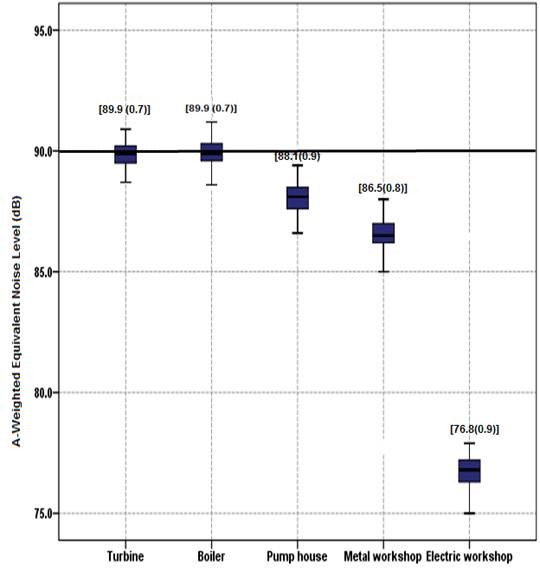
Figure (1): A-weighted equivalent noise levels at different work areas within the Power Station.
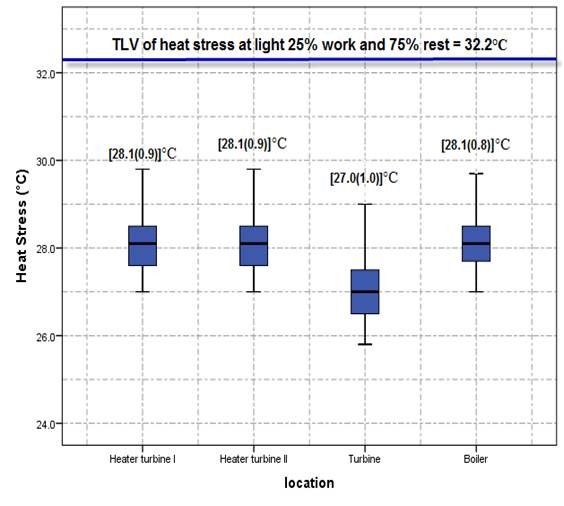
Figure (2): Heat Stress levels at different workplace areas within the Power Station.
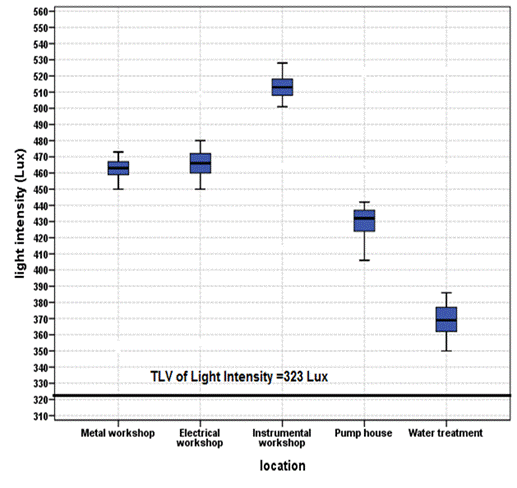
Figure (3): Light intensity levels at different workplace areas (Metal workshop, Electrical workshop, Instrumental workshop, Pump house, and Water treatment) within the Power Station.
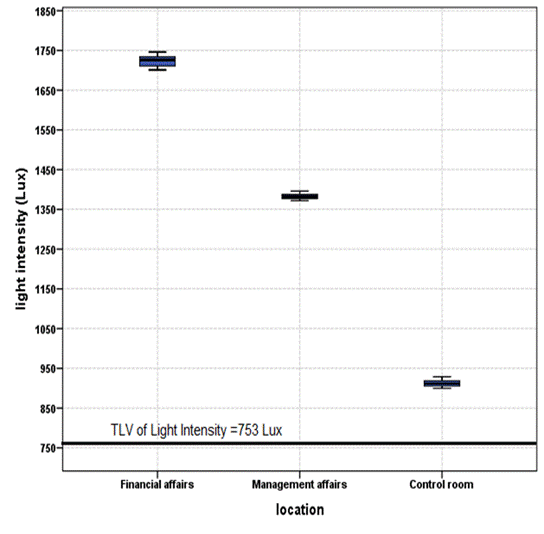
<
p align=”justify”>Figure (4): Light intensity levels at different workplace areas (Financial affairs, Management affairs, and Control room) within the Power Station.


 International Journal of Research (IJR)