
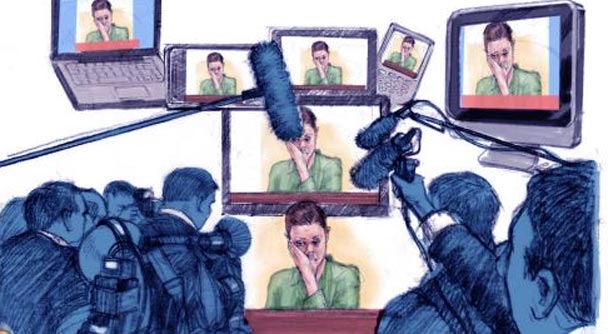
There have been numerous cases where the media has succeeded in bringing about change. It is a powerful influencer as it speaks directly to the public and can shape opinions. The Jessica Lal murder case is a strong example. The accused, Manu Sharma, was the son of Vinod Sharma, a wealthy and influential Congress MP from Haryana. Sharma tried to use his power to manipulate the case and did succeed initially by destroying evidence and turning witnesses hostile. The Delhi High Court was forced to acquit Sharma on grounds of lack of evidence. The acquittal resulted in a huge backlash throughout the nation which was helped on by the media. Jessica Lal’s sister, in an interview with Daily News and Analysis, said, “The media proved to be an extremely powerful force that came to our aid…It was the power of the media that enabled us to get justice. Had it not been for the media, people would have never known about how a family is being denied justice”.
However in another case, the media faced a lot of criticism. In the Ayushi Talwar murder case, Dr. Rajesh and Nupur Talwar were portrayed as guilty of the murder of their daughter and their servant, even though there was no such statement by the police and no conclusive evidence available. Media plays a vital role in moulding the opinion of the society and it is capable of changing the whole viewpoint through which people perceive various events. The media can be commended for starting a trend where the media plays an active role in bringing the accused to hook.
What critics of media trail say?
The Law Commission in its 200th report, Trial by Media: Free Speech versus Fair Trial under Criminal Procedure (Amendments to the Contempt of Courts Act, 1971), recommended a law to debar the media from reporting anything prejudicial to the rights of the accused in criminal cases, from the time of arrest to investigation and trial.
The media cannot be granted a free hand in the court proceedings as they are not some sporting event. Everyone has a right to free and fair trail and the media cannot take this away even from people accused of most heinous crimes.
The right to fair trial has not explicitly been made a fundamental right. That does not mean that it is a less important right. More than a legal right, it is basic principle of natural justice that everyone gets a fair trial and an opportunity to defend oneself. The commission believed that biased reporting by media publications have a prejudicial impact on the suspects, accused, witnesses and even judges and in general on the administration of justice. This is criminal contempt of court, according to the commission; and for that laws should be made to impose reasonable restrictions on freedom of speech.
What the media says?
This is really a grey area and laws can be used to gag the media unnecessarily. Governments accused of corruption will try to suppress the truth during trial if media is not allowed to report on cases of misgovernance, corruption etc. It is true that contempt of court is a ground for restricting the freedom of speech, but the media has not tried to lower the dignity of the judiciary by exposing loopholes of the investigation and the prosecution. And if judicial decisions also appear to be arbitrary, they must be subjected to ruthless scrutiny. It will be dangerous to gag the press in the name of contempt of court. If the appellate court feels that the media publicity affected fair trial, it can always reverse the decision of the lower court.
Instead of a law gagging media, there should be a self-regulatory body with sufficient punitive powers. The existing bodies of PCI and NBA are merely organizations that can give out a warning but cannot take any action. They should be given more powers so that they can punish media organizations that break rules and conduct unfair media trials.

 International Journal of Research (IJR)